Plan it
Board cut schedule
Every panel you'll need to cut, sized to actual milled lumber dimensions. Print this page or download the PDF to take into your workshop.
| Panel | Dimensions | Qty | Notes |
|---|---|---|---|
| Front | 5.5″ × 9.25″ | 1 | Drill 1.5" entrance hole 7" from the bottom, centered. Scuff the interior wood below the hole to provide a ladder for kits. |
| Back | 5.5″ × 16″ | 1 | Extends above and below the box for easy mounting to tree trunks. |
| Side | 5.5″ × 9″ | 2 | Cut top edge at a 10-degree angle to match the roof slope; one side should be hinged for cleaning. |
| Roof | 7.25″ × 9.5″ | 1 | Use 1x8 material to provide a 1.5" side overhang and a 2" front overhang to keep rain out. |
| Floor | 4″ × 4″ | 1 | Recess 1/4" inside the front and side panels; trim corners 1/2" for drainage. |
Source board layout
All body panels (front, back, sides) are cut from the standard 1x6 board. The floor is ripped to 4" to fit inside the 3/4" thick walls. The roof must be cut from a wider 1x8 board to ensure a proper drip edge on all sides.
Get materials
Shopping checklist
Check off items as you gather them — your progress is saved in your browser so you can come back to this page anytime.
Build it
Construction notes
- Wood: 3/4-inch (19 mm) untreated cedar, cypress, or redwood. Never use pressure-treated lumber or plywood.
- Boards: One 1" x 6" x 6' untreated cedar board provides the main body, plus a 10-inch scrap of 1" x 8" for the roof.
- Hardware: 20x 1-5/8" galvanized deck screws, 2x 1-1/2" exterior hinges, 1x brass swing latch or hook and eye, 2x 3" exterior mounting screws or 1/4" lag bolts
- Ventilation: Drill two 1/4-inch (6 mm) holes near the top of each side panel to provide cross-ventilation during summer months.
- Drainage: Clip the four corners of the floor panel at 45-degree angles to provide 1/2-inch gaps for moisture and waste drainage.
- Predator guard: Install a metal hole protector (reinforcing ring) to prevent larger squirrels from gnawing the hole wider. A 24-inch (61 cm) wide galvanized metal tree wrap should be placed 4 feet (1.2 m) below the box to stop climbing snakes and raccoons.
Install it
Place it & time it right
Mount boxes on mature hardwood trees like oaks or maples, ideally within 20 feet (6 m) of other trees to facilitate gliding paths. For social winter huddling, installing 2-3 boxes in a small grove can support a larger colony and increase success rates.
Seasonal timeline
When to install
Late autumn or early winter is ideal, as these squirrels look for warm communal nesting sites before the first hard freeze.
Nesting begins
Nesting typically begins in late February in the Southeast and Southwest. In the Northeast and Midwest, peak nesting occurs in April and May, with a frequent second brood in late summer.
Eggs & incubation
2-7 kits (usually 3-4) · 40 days
Fledging & cleaning
6-8 weeks until weaning; fully independent at 2.5 months · Clean the box in late autumn (October) before the winter huddle season begins. Remove all old nesting material and scrub with a 1:10 bleach-water solution if parasites are present.
Regional considerations
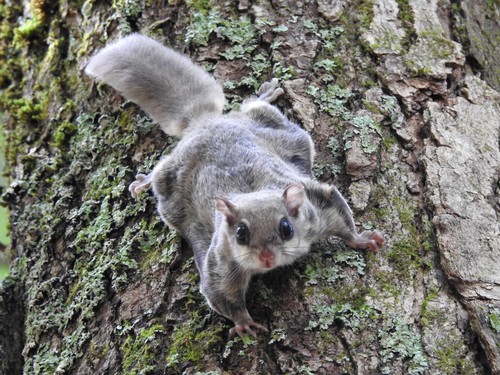
Southern Flying Squirrels are found throughout the eastern half of North America, from the Atlantic coast to the edge of the Great Plains, and from southeastern Canada down to Florida and the Gulf Coast.
In southern latitudes, these squirrels may breed year-round, whereas northern populations are strictly limited by spring thaw and the availability of mast (acorns and nuts). Higher elevation populations typically delay nesting until late spring to avoid late frosts.
Raccoons, rat snakes, and domestic cats are the primary threats. The recommended 1.5-inch entrance hole prevents larger raccoons from reaching in, while a tree-trunk baffle stops climbers from reaching the box.
Add a camera
Watch it happen
Because Southern Flying Squirrels are strictly nocturnal, a camera with high-quality Infrared (IR) night vision is essential. Mount a small, wide-angle USB 'cube' camera to the underside of the roof, focusing downward to capture their social huddling behavior. Ensure the lens is positioned away from the entrance hole to avoid 'washout' from outside ambient light.
For external monitoring, place a wireless outdoor camera on a neighboring tree trunk about 5-8 feet away, aimed at the entrance hole. This allows you to witness their spectacular 'launch' and 'landing' maneuvers. Cable management is critical; route all wires behind the box or inside a protective conduit to prevent the squirrels' sharp teeth from chewing through them.
A trail camera with a 'no-glow' flash is a great alternative for the perimeter, as it won't startle the animals during their active hours. Since these squirrels are highly social, especially in winter, use a camera that supports motion-activated recording to capture the peak activity just after dusk and before dawn.
Off-grid power with a USB solar panel
Nest boxes are almost always far from a power outlet. A 5V USB solar panel with a built-in battery is the cleanest solution — it powers most interior USB cameras, Blink cameras (via their USB port), and many trail cameras indefinitely.
- Panel position: Mount on the same post as the box, 1–2 ft above, angled 30–45° from vertical and facing south.
- Cable routing: Run inside split loom or 1/2″ conduit so squirrels can't chew it. Enter through the same grommeted hole as the camera cable.
- Battery buffer: Pick a panel with a 5–10 Ah battery so the camera runs through cloudy days and overnight for nocturnal species.
- Weatherproofing: Wrap every cable connection in self-amalgamating rubber tape.
Troubleshoot
Common problems & solutions
Grey squirrel chewing the hole wider
Attach a 1.5-inch metal hole protector or a piece of slate with a 1.5-inch hole over the entrance.
Box remains empty for a year
Ensure the box is at least 10 feet high and near a 'highway' of interconnected tree canopies; move it to a more mature hardwood stand.
Ants or wasps colonizing the box
Apply a thin layer of unscented bar soap to the interior ceiling to prevent wasps, and keep the area around the tree base clear of debris to deter ants.
Aggressive Red Squirrel competition
Install multiple boxes in the same area to reduce territorial pressure, as Southern Flying Squirrels are more social.
Common questions
Frequently asked questions
The ideal entrance hole size is 1.5 inches (38 mm). This allows the flying squirrel to enter easily while excluding larger, more aggressive grey squirrels and most raccoons.
Mount the box between 10 and 20 feet (3-6 m) high on a sturdy tree. They prefer higher elevations than most backyard birds to facilitate their gliding flight paths.
The best time is early winter or late autumn. This allows the squirrels to discover the box and use it for communal huddling during cold months before the spring breeding season.
Facing the box North or Northeast is best. This shields the entrance from the dominant westerly winds and prevents the box from overheating in the intense afternoon sun.
The 1.5-inch hole is the best deterrent. If they try to gnaw it wider, install a metal exclusion plate or a 'squirrel-proof' entrance ring to maintain the correct diameter.
In most of their range, they raise two broods per year—one in early spring and a second in late summer, depending on food availability.
Clean the box once a year in October. Be careful when opening, as they may already be using it for winter shelter; if occupied, leave it alone until the following year.
Take it with you
Download free PDF plans
Get a printable PDF with materials list, dimensions, assembly notes, and a QR code back to this page. We'll send occasional updates on new plans and habitat tips — unsubscribe anytime.
Prefer not to share your email? View materials online — everything is free and visible on this page.