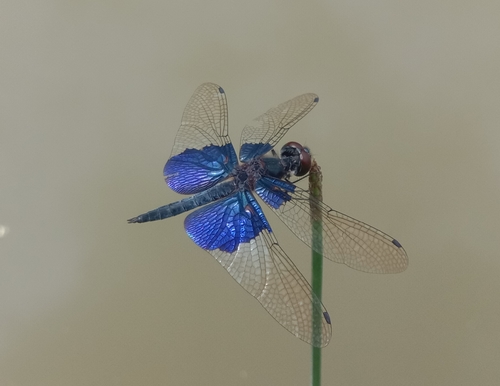
Asian Sapphire Flutterer
Rhyothemis triangularis
A living jewel of the wetlands, the Asian Sapphire Flutterer dazzles with its metallic blue wings and unique butterfly-like flight. This small but striking dragonfly is a master of the air and a favorite for backyard pond enthusiasts across Asia.
Quick Identification
Size
Body length of 25–30 mm (1.0–1.2 inches) with a wingspan of 45–60 mm (1.8–2.4 inches)
Colors
Deep iridescent sapphire or metallic navy blue on the basal half of the wings, with the outer half being transparent (hyaline). The body is a dark, matte black or deep brown.
Key Features
- Metallic sapphire-blue patches on the inner half of all four wings
- Butterfly-like fluttering flight pattern rather than typical dragonfly darting
- Small, slender dark abdomen
- Transparent wing tips that contrast sharply with the dark bases
When You’ll See Them
Geographic range
Where Does the Asian Sapphire Flutterer Live?
Asia is the native home of the Asian Sapphire Flutterer, where it is a common sight across the eastern and southern parts of the continent. Its core range encompasses a broad sweep from India and Sri Lanka in the west, through the tropical wetlands of Thailand, Vietnam, and Malaysia, reaching into the islands of Indonesia and the southern provinces of China. While it remains primarily within its native Asian territories, it is an adaptable species often found in human-modified landscapes wherever suitable freshwater exists.
Basemap © OpenStreetMap contributors
Behavior
The Asian Sapphire Flutterer is renowned for its distinctive, rhythmic flight style. Unlike the rapid, linear darting common to most dragonflies, this species flutters its wings in a manner that closely mimics a butterfly. This 'fluttering' is most prominent when they are patrolling their territory or performing courtship displays over the surface of still water. They are frequently seen gliding on thermal air currents on hot afternoons, appearing like floating bits of blue silk.
Males are notably territorial, selecting a prominent perch such as the tip of a reed or a twig overhanging a pond. From this vantage point, they aggressively defend their space against other males while waiting for small flying insects to pass by. Despite their territorial nature toward their own kind, they are relatively bold around humans and will often remain on their perch if approached slowly, making them excellent subjects for backyard observation.
EverydayEarth exclusive
Camera Tips
To capture the stunning iridescence of the Asian Sapphire Flutterer, camera placement is critical. Set your AI-powered camera on a tripod or mount just 1 to 2 feet above the water level, focusing on 'sentinel' perches. These dragonflies almost always return to the same protruding stick or reed after a hunting flight. Identifying these favored spots before setting your camera will significantly increase your hit rate.
Lighting is the 'secret sauce' for this species. The sapphire blue of their wings is structural color, meaning it looks best when the sun is behind the camera or hitting the wings at a slight angle. Avoid heavy shade; these insects love the sun. If your camera allows for shutter speed adjustments, try to keep it above 1/1000s to freeze the wing motion, or use a high-speed burst mode to capture the moment they transition from a stationary perch to their characteristic fluttering flight.
In a backyard setting, you can easily create a 'studio' for them. Place a few slender bamboo stakes or dry sticks at the edge of your pond, making sure they are the tallest points of vegetation in that specific spot. The Asian Sapphire Flutterer prefers the highest vantage point to survey its kingdom. By providing the perfect perch, you can effectively choose exactly where the dragonfly will land, allowing you to pre-focus your camera on that spot for professional-grade wildlife shots.
Frequently Asked Questions
Record Asian Sapphire Flutterer at your habitat
Connect a camera to start building your own species record — AI identifies every visitor automatically.