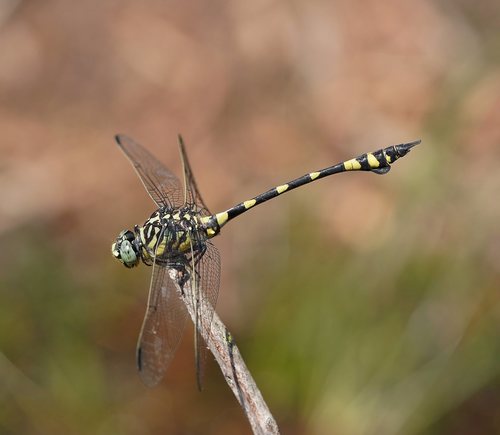
Australian Tiger
Ictinogomphus australis
With its striking yellow-and-black stripes and commanding presence, the Australian Tiger is one of the most impressive dragonflies in the Southern Hemisphere. A master of the sit-and-wait hunt, it patrols Australia's waterways with unmatched aerial precision.
Quick Identification
Size
Total length of 70-80 mm (2.8-3.1 inches) with a wingspan of approximately 90-100 mm (3.5-4 inches).
Colors
Distinctive bold yellow and black banding across the abdomen and thorax; clear, transparent wings with a dark spot (pterostigma) near the tips.
Key Features
- Widely spaced eyes on top of the head typical of the Gomphidae family
- Yellow and black 'tiger' striped abdomen
- Males have prominent leaf-like flaps (foliations) on segment eight
- Large, robust body with clear, powerful wings
When You’ll See Them
Geographic range
Where Does the Australian Tiger Live?
The Australian Tiger is native to the Australian continent, where it occupies a massive geographic arc stretching from the Kimberley region in Western Australia, across the Northern Territory, and down through Queensland and New South Wales. Its range finally reaches its southern limit at Point Hicks in eastern Victoria, making it a familiar sight across nearly all of Australia's northern and eastern coastal drainage systems. It is particularly common in areas where permanent freshwater provides a stable environment for its aquatic larvae.
Basemap © OpenStreetMap contributors
Behavior
The Australian Tiger is a formidable aerial predator known for its 'perch and pounce' hunting style. Unlike many other dragonfly species that spend hours on the wing, this species prefers to find a strategic vantage point on a reed, twig, or fence post near the water. From there, it monitors the surrounding air for small insects, launching explosive, high-speed sorties to intercept prey before returning to its favorite perch to feed.
These dragonflies are highly territorial and sun-loving. During the heat of the day, males can be seen patrolling the edges of rivers and ponds, aggressively chasing away rivals. They are often less wary of humans than smaller dragonflies, occasionally allowing close approach if they are focused on a hunt. At rest, they typically hold their wings flat and slightly forward, a classic pose for the clubtail family.
EverydayEarth exclusive
Camera Tips
To successfully capture an Australian Tiger on camera, you must focus on their habitual perching behavior. Identify a 'sentinel' branch—usually a bare twig or reed that sticks out prominently over the water or a garden pond. Place your camera on a tripod at roughly eye level with these perches (1-1.5 metres). Because these dragonflies return to the same spot repeatedly after a flight, you can pre-focus your lens on the tip of the branch and wait for the AI trigger to do the work.
Lighting is critical for bringing out the 'tiger' stripes. These insects are most active in direct, bright sunlight. Position your camera so the sun is behind you or at a 45-degree angle to the subject; this prevents the clear wings from disappearing into the background and highlights the metallic texture of their thorax. If your camera allows for high shutter speeds, set it to at least 1/2000th of a second to freeze the action if the dragonfly decides to hover or take off.
In a backyard setting, you can 'create' a photography stage by placing an attractive piece of driftwood or a bamboo stake near the edge of a pond. Australian Tigers are naturally drawn to these elevated positions. Avoid using infrared triggers at night, as these insects are strictly diurnal and will be tucked away in deep foliage once the sun goes down. Instead, set your camera to its most sensitive motion-detection settings during the peak heat of the day when their activity is at its maximum.
Frequently Asked Questions
Record Australian Tiger at your habitat
Connect a camera to start building your own species record — AI identifies every visitor automatically.