Boa Constrictor
Boa constrictor
The Boa Constrictor is one of the most iconic and recognizable snakes on Earth, famous for its intricate 'saddle' patterns and powerful ambush hunting style. A silent ghost of the South American rainforest, it plays a vital role in controlling rodent populations.
Quick Identification
Size
2 to 4 metres (6.5 to 13 feet) in length; typically weighing 10 to 27 kg (22 to 60 lbs)
Colors
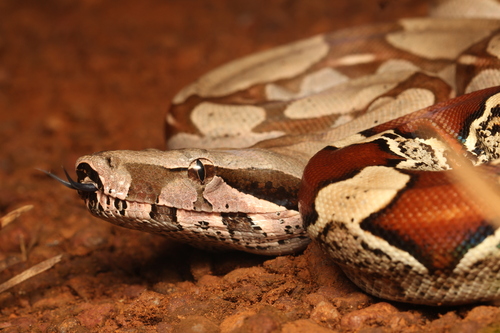
Tan, brown, or gray base color with dark brown or reddish-brown 'saddle' markings that become more vibrant and red toward the tail.
Key Features
- Distinctive dark saddle-shaped markings along the back
- Small, smooth scales with a metallic iridescent sheen
- Heavy-bodied with a triangular head and dark stripes extending from the eyes to the jaw
When You’ll See Them
Geographic range
Where Does the Boa Constrictor Live?
The Boa Constrictor is native to the vast tropical regions of South America, stretching from the northern reaches of Colombia and Venezuela down through the Amazon basin into Peru, Bolivia, and northern Argentina. It is a highly adaptable species found across nearly the entire continent east of the Andes mountains. While closely related species exist in Central America, the true Boa constrictor is a South American icon that has also established small, invasive populations in parts of Southern Florida due to the exotic pet trade.
Basemap © OpenStreetMap contributors
Behavior
The Boa Constrictor is a master of the 'sit-and-wait' predatory style. These snakes are primarily solitary and nocturnal, though they may emerge during the day to bask and regulate their body temperature. While they are highly capable swimmers, they spend much of their time on the ground or coiled in low-hanging branches. As semi-arboreal creatures, younger and smaller individuals are more likely to be found in trees, while larger, heavier adults tend to remain terrestrial.
Despite their fearsome reputation in popular culture, Boa Constrictors are generally non-aggressive toward humans unless they feel cornered or threatened. In the wild, they lead a quiet existence, relying on their exceptional camouflage to remain undetected by both prey and predators. When they do strike, they use their powerful bodies to constrict their prey, a process that shuts down the victim's circulatory system quickly and efficiently.
EverydayEarth exclusive
Camera Tips
Capturing a Boa Constrictor on camera requires a different approach than warm-blooded mammals because snakes are ectotherms. Standard Passive Infrared (PIR) sensors detect a difference between an animal's body heat and the background temperature; since a snake often matches the ambient temperature, it may not trigger the camera. To combat this, set your camera to 'Time Lapse' mode with a frequent interval (every 1-5 minutes) if you suspect a boa is frequenting a specific basking spot or trail.
For placement, focus on 'travel corridors' such as fallen logs that bridge gaps in vegetation or the edges of slow-moving water sources. Boas love to hug structural edges for protection. Mount your camera low to the ground—no higher than 12 inches—and angle it slightly downward to ensure the snake's low profile fills enough of the detection zone to trigger a recording if the temperature differential is sufficient.
Since these snakes are most active at night, ensure your camera has a high-quality 'No-Glow' or 'Low-Glow' infrared flash to avoid spooking the animal or washing out its intricate patterns. If you are in a backyard setting, creating a 'snake-friendly' zone with a large pile of rocks or hollow logs near a water feature can increase your chances of a sighting, as these provide the perfect micro-habitats for a boa to hide and wait for prey.
Frequently Asked Questions
Record Boa Constrictor at your habitat
Connect a camera to start building your own species record — AI identifies every visitor automatically.