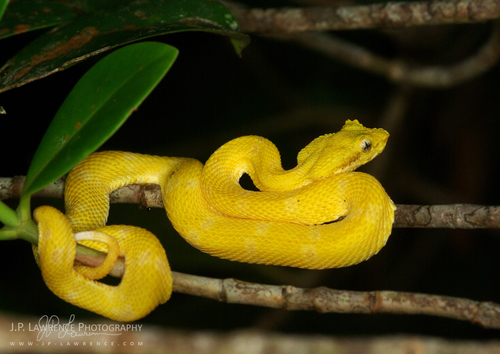
Central American Eyelash-Viper
Bothriechis nigroadspersus
A master of neotropical camouflage, the Central American Eyelash-Viper is famous for its vibrant color morphs and the distinctive 'eyelashes' that give it a truly prehistoric appearance.
Quick Identification
Size
45–75 cm (18–30 inches) in length; rarely exceeding 80 cm.
Colors
Extremely variable (polymorphic); individuals may be bright 'oropel' yellow, mossy green, reddish-brown, or grey with dark speckling and lichen-like patterns.
Key Features
- 2-3 modified scales above each eye resembling eyelashes
- Strongly prehensile tail used for anchoring to branches
- Triangular head with large heat-sensing pits between the eyes and nostrils
When You’ll See Them
Geographic range
Where Does the Central American Eyelash-Viper Live?
This stunning reptile is native to the humid lowlands and montane slopes of Central America and the extreme northwestern portion of South America. Its core range spans from southeastern Nicaragua through Costa Rica and Panama, extending into the Chocó-Darién region of Colombia and coastal Ecuador. It thrives in high-humidity environments where dense foliage provides ample hunting perches and cover.
Basemap © OpenStreetMap contributors
Behavior
The Central American Eyelash-Viper is a patient ambush predator that spends the vast majority of its life above the ground. It is primarily nocturnal, remaining coiled and motionless on low-hanging branches or vines during the day. Despite its venomous nature, it is not an aggressive species; it relies heavily on its remarkable camouflage to avoid detection, only striking if it feels directly threatened or if prey wanders within its reach.
These vipers are known for their 'site fidelity,' meaning an individual may return to the exact same hunting perch for several nights in a row. They use their prehensile tails to secure themselves while striking at passing prey. While they are solitary, they are often seen by humans in coffee or cacao plantations, where their presence is actually beneficial for controlling rodent populations, though workers must be cautious of their presence on low branches.
EverydayEarth exclusive
Camera Tips
Capturing a Central American Eyelash-Viper on camera requires a different approach than typical ground-dwelling wildlife. Because these are arboreal snakes, you should mount your camera at chest or eye level, specifically targeting 'cluttered' vertical structures. Look for thin vines, palm fronds, or large-leafed plants like Heliconias. These vipers often position themselves near blossoms to ambush hummingbirds, so aiming your camera at a known nectar source in the understory is an excellent strategy.
Since they are small and cold-blooded, traditional PIR (Passive Infrared) motion sensors on trail cameras may struggle to trigger. For the best results, use a camera with a high-sensitivity setting or one capable of 'Time-Lapse' mode, which takes photos at set intervals regardless of movement. If your camera has a macro or close-focus lens attachment, use it; these snakes are often found just a few feet from the lens and a standard focus might result in a blurry subject.
Nighttime is when the action happens. Ensure your camera's infrared flash is not too powerful, as it can 'white out' the snake's reflective scales at close range. If possible, use 'Low Glow' or 'No Glow' LEDs to avoid startling the snake or attracting unwanted attention to your gear. Placing a small, safe attractant like a hummingbird feeder nearby can indirectly bring the viper into frame by attracting its primary prey.
Frequently Asked Questions
Record Central American Eyelash-Viper at your habitat
Connect a camera to start building your own species record — AI identifies every visitor automatically.