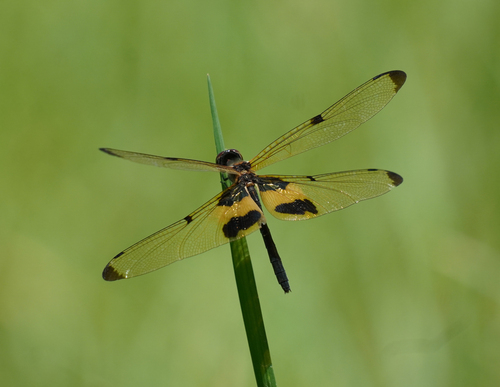
Common Picture Wing
Rhyothemis variegata
Often mistaken for a butterfly, the Common Picture Wing is one of the most artistic dragonflies in the world. Its stained-glass wings and gentle flutter make it a favorite for backyard observers across the Asia-Pacific.
Quick Identification
Size
Body length of 30–40 mm (1.2–1.6 inches) with a wingspan of 50–70 mm (2–2.8 inches)
Colors
Bright yellow wings with irregular black and brown bands and spots; males often show more intense dark patches and a metallic green/black body
Key Features
- Broad, butterfly-like wings with intricate yellow and black patterns
- Weak, fluttering flight style unlike typical dragonflies
- Metallic green or black thorax and abdomen
- Often found perching on the tips of tall grass or reeds
When You’ll See Them
Geographic range
Where Does the Common Picture Wing Live?
The Common Picture Wing is primarily native to the tropical and subtropical regions of South Asia and the Asia-Pacific. Its core territory stretches from India and Sri Lanka across Indochina and southern China, extending through the Indonesian archipelago into Papua New Guinea and northern Australia. You will typically find it thriving in lowland areas where warm temperatures and standing water are abundant.
Basemap © OpenStreetMap contributors
Behavior
The Common Picture Wing is most famous for its distinctive flight. Unlike the rapid, darting movements of most dragonflies, this species has a slow, fluttering gait that closely mimics a butterfly. This deceptive flight pattern is thought to potentially confuse predators who might mistake it for a less agile insect. They are highly social and are frequently seen in large, loose swarms, especially during the late afternoon as they forage for small gnats and flies above the vegetation.
These dragonflies are quite sensitive to temperature and are most active when the sun is bright. On overcast or rainy days, they tend to retreat into deep foliage or the underside of leaves for protection. While they are not territorial in the aggressive way many skimmers are, males will still patrol small patches of water or fields to find mates, occasionally engaging in mid-air spiraling displays with rivals.
EverydayEarth exclusive
Camera Tips
Capturing the Common Picture Wing on a backyard camera requires a focus on their favorite perching spots. Unlike ground-dwelling wildlife, these dragonflies love 'sentinel posts'—the very tips of tall grass, garden stakes, or dried reeds near water. Position your AI camera about 3 to 4 feet off the ground, angled slightly upward toward these tips. Using a macro lens or a camera with a short minimum focal distance is essential to capture the intricate 'picture' patterns on their wings.
Because they are small and fast-moving, standard PIR (Passive Infrared) motion sensors might struggle to trigger. If your camera supports it, use a high-speed time-lapse mode during the peak hours of 10 AM to 2 PM, or set your AI to look specifically for 'insects' or 'small flying objects.' To attract them to your frame, consider placing a few vertical bamboo skewers or tall flowering plants like Marigolds in an open, sunny spot; they will use these as hunting platforms to scan for gnats.
Lighting is your best friend with this species. The yellow in their wings is translucent and looks most spectacular when backlit by the sun. Try to orient your camera so it faces the morning or late afternoon sun (North or South orientation is usually best to avoid direct lens flare) to get that stained-glass effect through the wings. If you are using a trail cam for video, set the shutter speed as high as possible to reduce motion blur from their fluttering wings.
Frequently Asked Questions
Record Common Picture Wing at your habitat
Connect a camera to start building your own species record — AI identifies every visitor automatically.