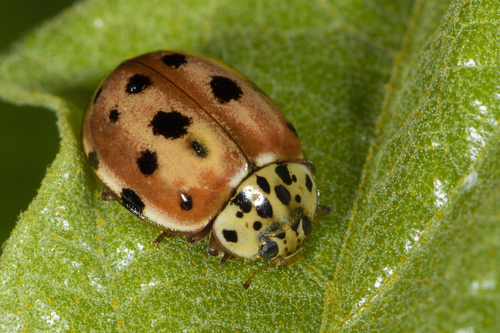
Cream-streaked Ladybird
Harmonia quadripunctata
A specialized hunter of the pine canopy, the Cream-streaked Ladybird is a beautiful and beneficial guest in any evergreen garden. With its variable markings and preference for conifer aphids, it is a fascinating subject for backyard wildlife enthusiasts.
Quick Identification
Size
5.5–11 mm (0.2–0.4 inches) in length
Colors
Cream, pale yellow, or orange-brown elytra with variable black spots; white or cream pronotum with four distinct black marks
Key Features
- Broad, oval body 5.5-11mm long
- Four distinct black spots on the light-colored pronotum
- Usually found on or near coniferous trees
- Elytra often feature cream-colored streaks or pale patches
When You’ll See Them
Geographic range
Where Does the Cream-streaked Ladybird Live?
The Cream-streaked Ladybird is native to the Palearctic region, with a core range stretching across Europe, North Africa, and Western Asia. It is widely distributed from the British Isles and Scandinavia down to the Mediterranean and eastward through Russia. In recent years, it has also been recorded as an introduced species in parts of the Northeastern United States and Eastern Canada, where it is slowly expanding its footprint in temperate forest zones.
Basemap © OpenStreetMap contributors
Behavior
The Cream-streaked Ladybird is a specialized predator that spends the majority of its life high in the canopy of coniferous trees. Unlike its more famous relative, the Seven-spot Ladybird, this species has evolved a specific preference for hunting aphids that inhabit pine, spruce, and fir needles. They are highly active during the day, using their sensitive antennae to track the chemical signals of their prey across the branches.
While they are generally solitary hunters, these beetles exhibit interesting social behavior during the transition into winter. In late autumn, they descend from the treetops to find sheltered crevices for hibernation. During this time, they may form small clusters on the bark of trees or the sunny sides of wooden structures. They are gentle insects that provide a vital service to gardeners by keeping ornamental evergreens free of sap-sucking pests.
EverydayEarth exclusive
Camera Tips
To capture the Cream-streaked Ladybird on a backyard camera, your placement is everything. You must focus your lens on the branches of coniferous trees like Scots Pine or Norway Spruce. Because these beetles are small, a macro lens or a camera with a very short focal distance is required. Mount the camera securely to a branch or use a tripod nearby, ensuring the frame is filled with pine needles where aphids are likely to congregate.
Lighting is the biggest challenge when photographing glossy beetles. Direct midday sun can create 'hot spots' on their elytra that wash out the cream-colored streaks. For the best results, set your camera to trigger during the 'golden hours' of early morning or late afternoon when the light is diffused. If your camera has adjustable settings, a fast shutter speed is helpful to freeze the beetle's movement as it scurries between needles.
During the autumn, you can change your strategy by placing the camera near south-facing wooden fences or window frames near evergreen trees. The beetles often congregate here to soak up the sun's warmth before finding a spot to overwinter. A time-lapse setting can capture the fascinating way they cluster together. Avoid using artificial lures; instead, look for the presence of 'honeydew' (a sticky substance left by aphids), which is the most reliable natural indicator that Cream-streaked Ladybirds are nearby.
Frequently Asked Questions
Record Cream-streaked Ladybird at your habitat
Connect a camera to start building your own species record — AI identifies every visitor automatically.