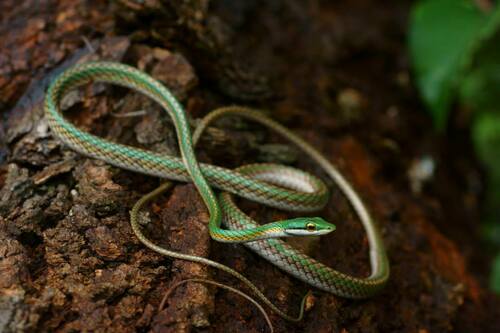
Giant Parrot Snake
Leptophis ahaetulla
A vibrant emerald master of the treetops, the Giant Parrot Snake is a slender, lightning-fast hunter of the tropical canopy. With its brilliant iridescent scales and keen golden eyes, it is one of the most striking reptiles found in the American tropics.
Quick Identification
Size
1.2–1.7 metres (4–5.5 feet) in length; rarely exceeding 2 metres (6.5 feet)
Colors
Brilliant iridescent green or golden-bronze upper body; cream, yellow, or white underside; distinctive black horizontal stripe through the eye
Key Features
- Extremely slender, whip-like body
- Large, prominent eyes with round pupils
- Vibrant lime-green or bronzy scales
- Black mask-like stripe through the eye
- Long tail comprising nearly 30-40% of total length
When You’ll See Them
Geographic range
Where Does the Giant Parrot Snake Live?
The Giant Parrot Snake is a quintessential Neotropical species, native to a massive area stretching from southern Mexico through Central America and deep into South America. It is commonly found throughout the Amazon Basin and as far south as northern Argentina and Uruguay. This species thrives in humid, tropical environments where dense canopy cover provides both hunting grounds and protection from predators.
Basemap © OpenStreetMap contributors
Behavior
The Giant Parrot Snake is a high-energy, diurnal hunter that spends the vast majority of its life in the forest canopy. Unlike many heavier-bodied snakes that rely on camouflage and ambush, the Parrot Snake is an active searcher, using its keen eyesight to track frogs and lizards through the branches. It is remarkably agile, capable of spanning gaps between trees with surprising speed, often appearing like a literal green streak through the foliage.
When this snake feels cornered, it employs a dramatic bluffing tactic rather than immediately biting. It will coil the front of its body and open its mouth exceptionally wide, revealing a dark interior to intimidate perceived threats. While they possess a mild venom used to subdue small prey, they are generally shy around humans and will flee into the densest parts of the canopy at the first sign of a disturbance.
EverydayEarth exclusive
Camera Tips
To capture the Giant Parrot Snake on camera, you must think vertically. These snakes are strictly arboreal, meaning a ground-level trail camera will almost never see them. Mount your AI-powered camera 5 to 10 feet up a tree trunk or on a sturdy limb. Focus on 'canopy highways'—horizontal branches or thick vines that connect different trees—as these are the primary transit routes the snake uses to navigate its territory.
Lighting is crucial for this species. Because they are active during the day, position your camera to avoid direct midday sun, which can cause harsh glares on their shiny, iridescent scales. Aim for a spot with dappled sunlight, which highlights their vibrant green color without washing out the image. Setting your camera to a high frame rate for video is highly recommended; these snakes move with a fluid, whip-like motion that is far more impressive in motion than in a still photo.
Since you can't easily bait a parrot snake with food, look for natural 'magnets.' If you have a garden, placing a camera near an elevated bird bath or a tree-shaded pond where frogs congregate will significantly increase your chances. They are most active during the rainy season when frog activity is at its peak. Ensure your camera's trigger speed is set to its fastest possible setting, as these snakes are known for their 'blink-and-you-miss-it' speed when traveling through the leaves.
Similar Species
Species that look similar or are commonly confused with Giant Parrot Snake.
Green Vine Snake
Has a much longer, pointed snout and a more triangular head compared to the Parrot Snake.
Brown Vine Snake
Usually bronze or brown in color and significantly thinner, with an extremely elongated snout.
Emerald Tree Boa
Much thicker body, slow-moving, and has white 'lightning bolt' markings across its back.
Frequently Asked Questions
Record Giant Parrot Snake at your habitat
Connect a camera to start building your own species record — AI identifies every visitor automatically.