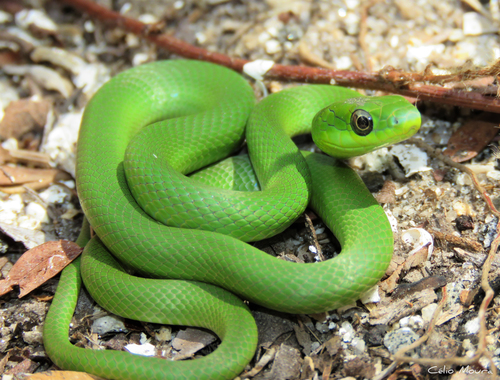
Lichtenstein's Green Racer
Philodryas olfersii
The Lichtenstein's Green Racer is a vibrant, emerald-hued marvel of the South American landscape. Known for its lightning-fast movement and arboreal grace, this diurnal hunter is a favorite for backyard wildlife enthusiasts.
Quick Identification
Size
Adults typically measure 100 to 150 cm (3.3 to 5 feet) in length and weigh approximately 200 to 500 grams.
Colors
Brilliant emerald or leaf-green body, often featuring a distinct dark brown or blackish stripe along the spine; the belly is a contrasting pale cream or yellow-green.
Key Features
- Slender, whip-like body profile
- Large, expressive eyes with round pupils
- Dark vertebral stripe running down the back
- Elongated and slightly pointed snout
When You’ll See Them
Geographic range
Where Does the Lichtenstein's Green Racer Live?
This species is a native icon of South America, boasting an expansive range that covers much of the continent's eastern and central regions. It is most commonly encountered throughout Brazil, Paraguay, Uruguay, and northern Argentina, though its territory also extends into the lowland forests of Bolivia and eastern Peru. Because it thrives in both wild and modified landscapes, it is one of the most frequently recorded green snakes in South American residential areas.
Basemap © OpenStreetMap contributors
Behavior
The Lichtenstein's Green Racer is a highly active, diurnal predator known for its incredible speed and agility. It is a semi-arboreal species, meaning it is just as comfortable gliding through the canopy of trees as it is racing across the forest floor. Unlike many snakes that rely on ambush tactics, this species often actively pursues its prey, using its keen eyesight to track movement from a distance.
While generally shy and quick to retreat from human presence, the Green Racer can be defensive if it feels trapped. It is a member of the Dipsadinae subfamily and possesses a Duvernoy's gland, which produces a medically significant venom. While bites to humans are rarely fatal, they can cause severe local swelling, pain, and bruising, so this snake should always be observed with respect and from a safe distance.
EverydayEarth exclusive
Camera Tips
To successfully capture a Lichtenstein's Green Racer on camera, you must account for their semi-arboreal nature. Mount your AI-powered camera at chest height (about 4 to 5 feet) and angle it toward horizontal structures like fence rails, low tree limbs, or the tops of stone walls. These snakes use these 'highways' to navigate through gardens while staying off the ground where they are more vulnerable to predators.
Since snakes are ectothermic, traditional PIR (Passive Infrared) sensors on trail cameras can struggle to detect them if the snake's body temperature matches the surrounding air. To overcome this, use a camera with advanced AI motion detection or set your camera to 'Time Lapse' mode with short intervals during the peak morning hours. High frame-rate video settings are also highly recommended, as the 'Racer' lives up to its name and can cross a camera's field of view in a matter of seconds.
You can 'bait' your camera area indirectly by creating a micro-habitat that attracts their prey. A small, shallow rock pool or a patch of native flowering plants will attract the lizards and frogs that the Green Racer hunts. Position your camera to overlook these hunting grounds. The best lighting for these iridescent green snakes is mid-morning sun; if your camera has adjustable exposure, ensure it isn't blown out by the bright tropical sun, which can wash out the snake's beautiful emerald scales.
During the wetter months (October to March), these snakes are most active. If your camera allows for sensitivity adjustments, turn them to 'High' during this period. Check for 'hotspots' near woodpiles or dense hedges where they might hide during the hottest part of the day. A well-placed camera in a transition zone between a manicured lawn and a wilder, shrubby area is often the most productive spot for capturing high-quality footage of this species.
Similar Species
Species that look similar or are commonly confused with Lichtenstein's Green Racer.
Frequently Asked Questions
Record Lichtenstein's Green Racer at your habitat
Connect a camera to start building your own species record — AI identifies every visitor automatically.