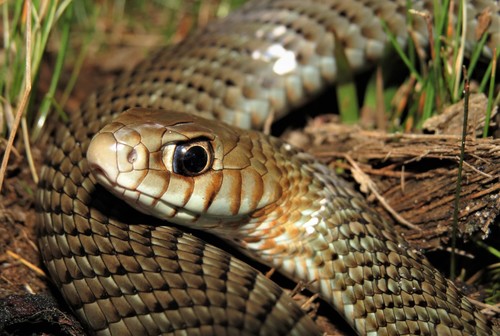
Patagonian Racer
Philodryas patagoniensis
The Patagonian Racer is a swift, olive-hued guardian of the South American pampas. Known for its incredible speed and role as a natural pest controller, this diurnal hunter is a fascinating visitor to suburban gardens and wild grasslands alike.
Quick Identification
Size
Adults typically reach 70-150 cm (2.3-4.9 ft) in length; females are generally larger and more robust than males.
Colors
Olive-green, tan, or brownish-grey dorsal scales often with dark edges; the underside is typically a uniform cream or pale yellow.
Key Features
- Slender, streamlined body adapted for high speed
- Large, alert eyes with round pupils
- Pointed, slightly prominent snout for foraging in leaf litter
When You’ll See Them
Geographic range
Where Does the Patagonian Racer Live?
Native to the cis-Andean regions of South America, the Patagonian Racer maintains a massive geographic footprint. Its territory stretches from the tropical landscapes of northeastern Brazil through the heart of Paraguay and Uruguay, reaching down into the central pampas of Argentina. Despite its common name, it is most densely populated in the temperate and subtropical grasslands rather than the arid, cold regions of deep southern Patagonia.
Basemap © OpenStreetMap contributors
Behavior
The Patagonian Racer is a highly active, diurnal snake known for its impressive speed and agility. Unlike heavy-bodied ambush predators, this species is an active hunter that constantly moves through its environment to flush out prey. It is primarily terrestrial, though it is a capable climber and is frequently seen navigating low bushes or fence lines. While generally shy and quick to flee from humans, it can exhibit defensive displays, such as flattening its neck or striking, if it feels cornered.
As a rear-fanged (opisthoglyphous) species, it possesses venom that is effective at subduing small animals. While it is not considered life-threatening to humans, bites can cause localized pain, swelling, and discoloration, so it should always be treated with respect. In suburban environments, they are often viewed as beneficial neighbors because they provide excellent natural pest control, keeping populations of rodents and garden-raiding lizards in check.
EverydayEarth exclusive
Camera Tips
To capture the Patagonian Racer on your backyard or trail camera, focus your efforts on 'transition zones.' These are areas where shorter grass meets thicker brush or woodpiles, as the snake uses these edges for both hunting and protection. Because these snakes are low to the ground and move quickly, mount your camera no higher than 10-15 centimeters (4-6 inches) off the ground. Angle the lens slightly downward to ensure you catch the head and body rather than just a glimpse of a tail as it passes.
Sun-drenched spots are ideal for placement, as these snakes are diurnal and rely on the sun for thermoregulation. Flat rocks, stone walkways, or the base of a garden wall are perfect 'basking' locations. If your camera has a high-speed trigger or burst mode, enable it; the Patagonian Racer is named for its speed, and a standard single-shot setting may result in many empty frames or blurred images of a disappearing tail. Video mode is often the best choice for capturing their fluid movement.
While you cannot easily bait a snake directly, you can attract them by creating a 'micro-habitat' within the camera's field of view. A shallow water dish or a loosely stacked pile of logs will attract lizards and amphibians, which are the primary food source for the racer. In the heat of mid-summer, focus your monitoring on the morning and late afternoon hours, as the snakes will often retreat to the shade during the peak midday sun to avoid overheating.
Similar Species
Species that look similar or are commonly confused with Patagonian Racer.
Frequently Asked Questions
Record Patagonian Racer at your habitat
Connect a camera to start building your own species record — AI identifies every visitor automatically.