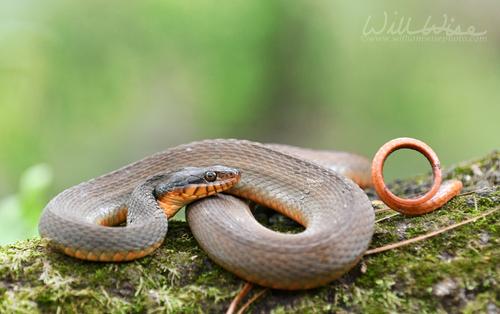
Plain-bellied Watersnake
Nerodia erythrogaster
A robust and vibrant resident of North American wetlands, the Plain-bellied Watersnake is famous for its colorful, unmarked underside and its surprising habit of wandering far from the water's edge.
Quick Identification
Size
76-122 cm (30-48 inches) in length; weight varies by age and sex, typically 200-600g
Colors
Dark olive, brown, or gray-black dorsal; solid, unpatterned belly ranging from bright yellow to orange or reddish-pink
Key Features
- Plain, unmarked belly (yellow to red)
- Heavily keeled (rough) scales
- Large, stocky body with a thick neck
- Round pupils and dark vertical labial bars on the jaw
When You’ll See Them
Geographic range
Where Does the Plain-bellied Watersnake Live?
Native to the North American continent, the Plain-bellied Watersnake is a staple of the southeastern and central United States. Its core range extends from the Atlantic coastal plains through the Gulf Coast states, reaching as far west as New Mexico and as far north as the Great Lakes region and Michigan. These snakes are also found in localized populations across northeastern Mexico, thriving in almost any environment with permanent or semi-permanent water sources.
Basemap © OpenStreetMap contributors
Behavior
Plain-bellied Watersnakes are distinctive members of the Nerodia genus, known for being more terrestrial than many of their aquatic relatives. While they are excellent swimmers and highly dependent on water for hunting, they are frequently found traveling overland between water sources or seeking shelter in upland forests. They are particularly active on the move during humid nights or following heavy rainstorms, which provides an excellent opportunity for camera sightings.
These snakes are active foragers rather than ambush predators. They spend a significant portion of their active hours patrolling the edges of ponds, lakes, and swamps for amphibians. When threatened, they exhibit a defensive temperament typical of watersnakes; they will hiss loudly, flatten their bodies to appear larger, and release a pungent musk from their cloacal glands. While they are non-venomous and generally shy away from human contact, they are bold defenders if cornered.
EverydayEarth exclusive
Camera Tips
To capture the Plain-bellied Watersnake, placement is everything. Focus your camera on the transition zones where water meets land. Look for logs or flat rocks that receive morning sun; these are prime basking spots. Set your camera low to the ground, no more than 6-12 inches high, and angle it slightly downward to ensure the PIR sensor picks up the heat signature of a snake that has been warming in the sun. If you are near a pond, a camera aimed at a clear patch of muddy shoreline or a 'snake run' through tall grass is often more productive than aiming at open water.
Because these snakes are more terrestrial than other species, they are frequently caught on trail cameras during 'overland crawls' after heavy rain. If you have a wooded area adjacent to a creek or pond, placing a camera along a fallen log or a natural clearing during a humid summer night is a great strategy. Since snakes are ectothermic, standard PIR sensors can struggle to detect them if their body temperature matches the environment. Using a camera with a high-sensitivity setting or a 'Time Lapse' mode that takes a photo every few minutes can significantly increase your chances of a sighting.
Nighttime is when these snakes are most active during the peak of summer. Ensure your camera has a high-quality infrared flash that won't blow out the image on a reflective, wet snake. Avoid using white LED flashes, which might startle the animal and result in a blurred image as it retreats. For the best identification shots, try to capture the side profile where the dark back meets the vibrant, solid-colored belly—this is the most definitive field mark for this species.
Similar Species
Species that look similar or are commonly confused with Plain-bellied Watersnake.
Northern Cottonmouth
Cottonmouths have vertical pupils, a blockier head, and a heat-sensing pit, while the Plain-bellied Watersnake has round pupils and lacks the dark 'Zorro' mask across the eye.
Banded Watersnake
Banded Watersnakes have clear dark bands along the entire length of the body and a patterned belly, unlike the uniform dorsal and plain ventral of the Plain-bellied.
Frequently Asked Questions
Record Plain-bellied Watersnake at your habitat
Connect a camera to start building your own species record — AI identifies every visitor automatically.