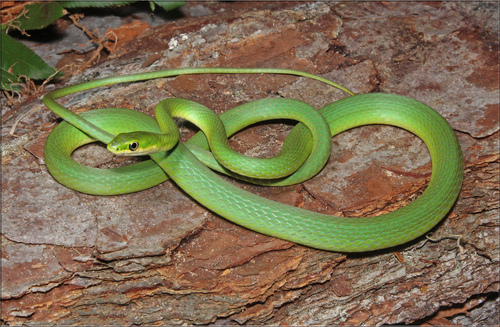
Rough Greensnake
Opheodrys aestivus
Often mistaken for a living vine, the Rough Greensnake is a gentle, emerald-colored climber that brings a touch of the exotic to North American backyards. This docile insect-hunter is a master of camouflage, blending perfectly into the leafy heights of gardens and forests.
Quick Identification
Size
22-46 inches (56-116 cm) in length; extremely slender build
Colors
Uniform bright emerald green upper body with a contrasting pale yellow or cream-colored belly; no distinct markings
Key Features
- Keeled (ridged) scales giving a 'rough' texture
- Extremely slender, vine-like body
- Large eyes with circular pupils
- Bright green dorsal color that turns blue after death
When You’ll See Them
Geographic range
Where Does the Rough Greensnake Live?
The Rough Greensnake is native to the North American continent, specifically concentrated in the Southeastern and Central United States. Its range extends from southern New Jersey down the Atlantic coast to Florida, reaching as far west as Central Texas, Oklahoma, and Kansas. While it is most abundant in the humid environments of the American South, isolated populations are also found in parts of northeastern Mexico along the Gulf Coast region.
Basemap © OpenStreetMap contributors
Behavior
The Rough Greensnake is an arboreal specialist, spending the vast majority of its life climbing through shrubs, vines, and low-hanging tree branches. Unlike many other snakes that flee across the ground, this species relies on its incredible camouflage to disappear into the foliage. When threatened, it often remains perfectly still or mimics the swaying of a branch in the wind. It is famously docile and almost never attempts to bite humans, even when handled.
During the day, these snakes are active hunters, using their keen eyesight to track down moving prey among the leaves. At night, they sleep coiled near the ends of branches where they can detect the vibrations of approaching predators. They are semi-social during brumation, sometimes sharing winter dens with other snake species to conserve heat.
EverydayEarth exclusive
Camera Tips
To capture a Rough Greensnake on camera, you must think vertically. Standard trail camera placements at knee-height will likely miss them. Instead, mount your camera 4-6 feet high, angled toward dense, sun-dappled foliage, garden trellises, or blackberry thickets. Because these snakes are cold-blooded and move slowly, traditional PIR motion sensors may not always trigger; using a time-lapse mode with 30-second intervals during the morning hours is often more effective.
Focus your efforts on 'edge' habitats—places where a manicured lawn meets a wilder brush line or near the margins of a backyard pond. These snakes love to bask on thin outer branches that hang over water or open spaces. If your camera has a macro or close-focus setting, use it, as these snakes are quite slender and can easily get lost in a wide-angle landscape shot.
Avoid using traditional baits, as these snakes only respond to live, moving insect prey. Instead, attract the snake by attracting its food; planting native nectar-rich flowers that draw in grasshoppers and caterpillars will naturally bring Rough Greensnakes into your camera's field of view. The best lighting occurs in mid-morning when the snakes emerge from the inner canopy to bask and raise their body temperature for the day's hunt.
Similar Species
Species that look similar or are commonly confused with Rough Greensnake.
Smooth Greensnake
Lacks the ridged (keeled) scales of the Rough Greensnake and is much more likely to be found on the ground in open grassy fields.
North American Racer (Juvenile)
Though adults are dark, juveniles can be patterned; however, they lack the uniform emerald green color and have much thicker bodies.
Frequently Asked Questions
Record Rough Greensnake at your habitat
Connect a camera to start building your own species record — AI identifies every visitor automatically.