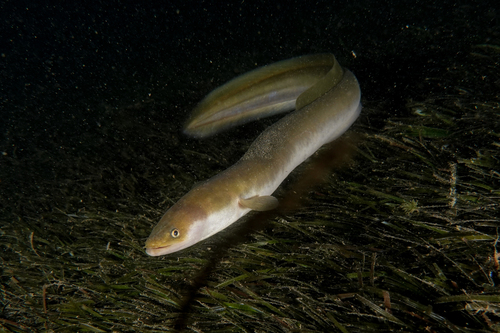
Short-finned Eel
Anguilla australis
The Short-finned Eel is a master of migration, traveling thousands of miles from backyard ponds to the deep ocean. This resilient voyager can even cross dry land, slithering through damp grass to reach new waters.
Quick Identification
Size
30–110 cm (12–43 in) in length; weight typically ranges from 0.5 to 3 kg (1.1–6.6 lbs).
Colors
Uniform olive-green, dark brown, or bronzy-black on the back and sides, fading to a distinct yellowish or silvery-white belly.
Key Features
- Dorsal fin starts only slightly forward of the anal fin
- Elongated, cylindrical snake-like body
- Small, rounded pectoral fins located just behind the head
- Thick, protective skin covered in a heavy mucus layer
When You’ll See Them
Geographic range
Where Does the Short-finned Eel Live?
Native to the sprawling aquatic landscapes of the South Pacific, the Short-finned Eel is a cornerstone species of the waterways in south-eastern Australia and throughout both the North and South Islands of New Zealand. Its vast natural territory extends into the tropical reaches of New Caledonia, Fiji, and French Polynesia, as well as isolated islands like Norfolk and Lord Howe. This resilient traveler is equally at home in pristine mountain streams as it is in the drainage systems of major coastal cities.
Basemap © OpenStreetMap contributors
Behavior
The Short-finned Eel is a catadromous species, meaning it spends most of its adult life in freshwater rivers and lakes before migrating thousands of kilometers into the deep Pacific Ocean to spawn and die. They are primarily nocturnal hunters, spending their daylight hours tucked away in the mud, under submerged logs, or within dense aquatic vegetation. Their ability to absorb oxygen through their skin allows them to behave in ways few other fish can.
During periods of heavy rain or high humidity, these eels are famous for their overland excursions. They can slither across damp grass and mud like snakes to move between isolated ponds or to bypass obstacles like waterfalls and dams. While generally shy, they are highly curious and can become quite bold in suburban ponds, often learning to associate human presence with food offerings.
EverydayEarth exclusive
Camera Tips
To capture high-quality footage of the Short-finned Eel, you will need to think sub-aquatic. Since they are almost exclusively active under the cover of darkness, a waterproof action camera or a specialized underwater trail camera is essential. Position your camera in shallow water (20–40 cm deep) near the edge of a pond or a slow-moving river bank. Look for areas with 'structure' like overhanging roots or submerged rocks, as eels prefer to stay close to cover while navigating.
Baiting is the most effective way to ensure a close-up encounter. Use a small, perforated container—such as a mesh bag or a tea infuser—filled with smelly, oily bait like canned sardines, chopped squid, or wet cat food. Secure the bait directly in front of the camera lens, roughly 30 cm away. The scent trail will draw eels from down-current directly into your field of view. If you are tracking their overland movements, place a standard trail camera 15 cm off the ground along damp, grassy 'passes' between water bodies during the first heavy autumn rains.
Because eels have highly reflective, slimy skin, traditional white-light flashes will often cause a 'white-out' effect that hides all detail. Use a camera with 'No-Glow' or 'Black' infrared LEDs to minimize glare. Setting your camera to record 20-second video clips rather than still photos is highly recommended; the eel’s unique sinuous, undulating swimming motion is far more impressive and easier to identify on video than in a static, blurry image.
Check your camera settings to ensure the focus is set for close-range macro if possible, as eels will often swim right up to the lens to investigate the source of the scent. During the summer months, you may also catch them during the twilight hours of dusk, but for the best results, ensure your camera's night-vision sensors are clean and unobstructed by algae or floating debris.
Similar Species
Species that look similar or are commonly confused with Short-finned Eel.
Australian Long-finned Eel
The dorsal fin on the Long-finned Eel starts much further forward, and the skin often has a mottled or 'marbled' pattern compared to the plain color of the Short-finned Eel.
New Zealand Longfin Eel
Growing significantly larger (up to 2 meters), this species has a much longer dorsal fin and a more wrinkled skin appearance around the head.
Frequently Asked Questions
Record Short-finned Eel at your habitat
Connect a camera to start building your own species record — AI identifies every visitor automatically.