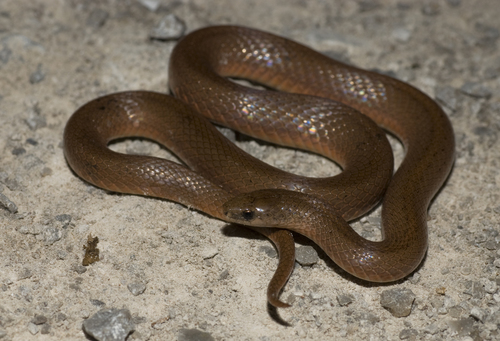
Smooth Earthsnake
Virginia valeriae
The Smooth Earthsnake is a shy, subterranean specialist that acts as a silent helper in many American gardens. Small and entirely harmless, this master of the leaf litter is a fascinating example of the 'hidden' wildlife living right beneath our feet.
Quick Identification
Size
18–25 cm (7–10 inches) in length; weight is negligible, typically under 20 grams
Colors
Uniformly gray, brown, or reddish-brown above; plain white, cream, or yellowish belly; occasionally features tiny black flecks on the dorsal surface
Key Features
- Completely smooth scales without keels
- Small, cone-shaped head with a pointed snout
- Small eyes with round pupils
- Uniform coloration with no distinct stripes or large markings
When You’ll See Them
Geographic range
Where Does the Smooth Earthsnake Live?
Native to the North American continent, the Smooth Earthsnake is found across the eastern and central United States. Its geographic range extends from southern Iowa and New Jersey in the north, stretching down to the Gulf Coast and eastern Texas. These snakes are particularly prevalent in the Atlantic Coastal Plain and the humid valleys of the Appalachian foothills, though they are rarely seen in the higher mountain peaks. While they have no known introduced populations, their ability to thrive in suburban mulch beds makes them much more common in residential areas than many people realize.
Basemap © OpenStreetMap contributors
Behavior
The Smooth Earthsnake is one of the most secretive and docile reptiles in North America. As a fossorial species, it spends the vast majority of its life hidden beneath the surface, navigating through loose soil, leaf litter, or rotting logs. Because they are so small and lack any venom or significant defensive bite, their primary survival strategy is remaining undetected. They are often only discovered by homeowners while gardening or moving landscaping timbers.
These snakes are largely solitary and are most active during periods of high humidity, particularly after warm spring or autumn rains. Unlike many other snakes that lay eggs, the Smooth Earthsnake is ovoviviparous, meaning the females give birth to live young during the late summer. They pose absolutely no threat to humans or pets and typically respond to being handled by simply trying to hide or releasing a mild musk.
EverydayEarth exclusive
Camera Tips
Capturing a Smooth Earthsnake on camera requires a specialized approach because of their small size and subterranean habits. Standard trail cameras mounted on trees will almost never trigger for this species. Instead, place your camera at ground level, ideally using a macro-focus lens or a camera with a short minimum focal distance. Positioning the camera near a 'cover object' like a flat rock, a piece of old plywood, or a large log is the best strategy, as these snakes use these items for thermoregulation and protection.
Because they are triggered by movement and heat, and these snakes are cold-blooded and move slowly, PIR sensors may struggle. Use a 'Time Lapse' mode set to take a photo every 30 to 60 seconds during the early morning and late evening hours, especially after a rain event. This increases your chances of catching one as it emerges from the soil to hunt earthworms on the surface. Focus your frame on a small area of bare, moist earth or the edge of a mulch pile.
To increase activity in front of the camera, maintain a 'wild' corner of your garden. A pile of damp leaves or a layer of organic mulch will attract the earthworms that these snakes prey upon. If you use a camera with high sensitivity, try placing it along a natural 'drift fence'—such as the edge of a garden shed or a long fallen branch—which naturally funnels ground-dwelling reptiles along a specific path. Ensure your camera is set to high-resolution video or burst-mode photos to distinguish the snake's uniform body from the surrounding brown leaf litter.
Similar Species
Species that look similar or are commonly confused with Smooth Earthsnake.
Rough Earthsnake
Has keeled (ridged) scales and only a single scale behind the eye, whereas the Smooth Earthsnake has smooth scales and two scales behind the eye.
DeKay's Brownsnake
Usually features two rows of dark spots connected by a light stripe down the back, whereas the Smooth Earthsnake is a solid, uniform color.
Red-bellied Snake
Features a bright red or orange underside and keeled scales, unlike the plain cream belly and smooth scales of the Earthsnake.
Frequently Asked Questions
Record Smooth Earthsnake at your habitat
Connect a camera to start building your own species record — AI identifies every visitor automatically.