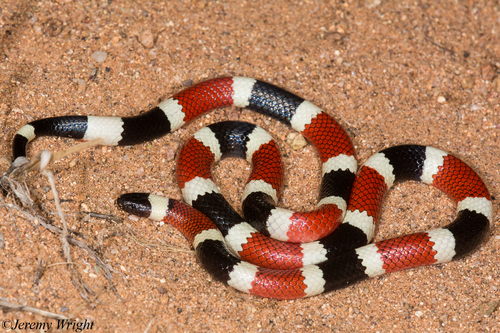
Sonoran Coralsnake
Micruroides euryxanthus
A shy jewel of the desert, the Sonoran Coralsnake is famous for its vibrant rings and secretive lifestyle. Though venomous, this small elapid is a fascinating neighbor for those living in the American Southwest.
Quick Identification
Size
11-24 inches (28-61 cm); very slender, often no thicker than a pencil
Colors
Bright, alternating rings of red, yellow (or cream), and black; the red and yellow rings always touch
Key Features
- Red and yellow rings touch ('Red on yellow, kill a fellow')
- Solid black snout
- Bands encircle the entire body, including the belly
- Small, blunt head not distinct from the neck
When You’ll See Them
Geographic range
Where Does the Sonoran Coralsnake Live?
Native to the North American Southwest, the Sonoran Coralsnake is a true desert specialist. Its core range is centered in the Sonoran Desert, stretching from central and southern Arizona through southwestern New Mexico. South of the border, its territory extends deep into Mexico, covering the states of Sonora, Chihuahua, and northern Sinaloa. While they are resident throughout this range, they are most frequently spotted in the rocky foothills and lush arroyos of the Arizona-Upland subdivision of the desert.
Basemap © OpenStreetMap contributors
Behavior
The Sonoran Coralsnake is an incredibly secretive and fossorial species, meaning it spends the vast majority of its life underground or hidden beneath leaf litter, rocks, and debris. Despite its potent neurotoxic venom, it is not aggressive and rarely encounters humans. When threatened, it employs a unique defensive display known as 'cloacal popping,' where it emits a loud, rhythmic sound from its vent to startle predators while hiding its head under its coiled body.
These snakes are primarily crepuscular, meaning they are most active during the twilight hours of dawn and dusk, though they may emerge at night during the hot summer months or during the day after a monsoon rain. Because they are specialists that hunt other small snakes, they are often on the move during the same windows when their prey is active. They do not bask in the open like many other reptiles, preferring the safety of cover.
EverydayEarth exclusive
Camera Tips
Capturing a Sonoran Coralsnake on camera requires strategic placement because they are low-profile and move primarily along the ground. Position your camera as low as possible—literally on the ground or mounted on a small stake just inches high. Aim the lens toward 'travel corridors' such as the base of a rock wall, the edge of a fallen log, or the margin where a garden meets natural desert wash. Because they are slender, you should use a camera with a high-trigger sensitivity and a wide-angle lens to ensure you catch them as they pass through the frame.
Lighting is a major challenge since these snakes are most active during low-light hours. Look for a trail camera with a high-quality 'no-glow' infrared flash to avoid startling the snake or creating a 'white-out' effect on its bright, reflective scales. If your camera allows for focal adjustments, set it for a close-range focus (3-5 feet), as these snakes are small and will appear as mere lines if the camera is too far away. Time-lapse mode can also be effective if you suspect a snake is frequenting a specific rock crevice.
While you cannot easily 'bait' a coralsnake with food, you can attract them by creating a hospitable environment. A small, drippy irrigation head or a damp area under a pile of flat rocks (a 'snake hotel') can attract both the coralsnake and its prey. The best time to check your footage is immediately following the first heavy rains of the summer monsoon season, which usually triggers a flurry of surface activity as the snakes emerge to hunt and mate.
Similar Species
Species that look similar or are commonly confused with Sonoran Coralsnake.
Frequently Asked Questions
Record Sonoran Coralsnake at your habitat
Connect a camera to start building your own species record — AI identifies every visitor automatically.