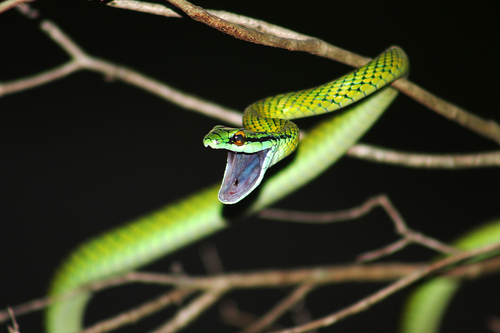
Southern Green Parrot Snake
Leptophis marginatus
A masterpiece of arboreal evolution, the Southern Green Parrot Snake is a vibrant, emerald-hued hunter that glides through the treetops of South America with unmatched grace.
Quick Identification
Size
Typically 100-150 cm (3.3-5 feet) in length; extremely slender with a tail making up nearly one-third of total length.
Colors
Vibrant emerald green or lime green on the upper body, often with a bronze or golden lateral stripe; belly is creamy white to pale yellow; eyes are large and bronze-colored.
Key Features
- Exceptionally slender, ribbon-like body
- Large, prominent eyes with round pupils
- Strongly keeled dorsal scales giving a textured appearance
- Black edging on some scales creating a faint 'net' pattern
When You’ll See Them
Geographic range
Where Does the Southern Green Parrot Snake Live?
This elegant reptile is a native of the South American Southern Cone, where it thrives in humid, vegetated environments. Its primary range encompasses the northern half of Argentina, the entirety of Paraguay, and much of Uruguay, reaching into the southern Brazilian states. It is most frequently found in riparian zones where forest edges meet water, providing the high humidity and abundant amphibian prey it requires.
Basemap © OpenStreetMap contributors
Behavior
The Southern Green Parrot Snake is a highly specialized arboreal hunter, spending the vast majority of its life navigating the canopy and understory of lush forests. Unlike many serpents that rely on ambush tactics, this species is an active searcher, using its keen eyesight to scan the leaves for movement. It moves with remarkable speed and agility through branches, often appearing to glide effortlessly across gaps in the foliage.
When confronted or threatened, this snake employs a dramatic bluffing display. It will inflate its neck slightly and open its mouth wide to reveal a dark, contrasting interior, making it look much more formidable than it actually is. Despite this aggressive appearance, they are non-venomous and generally prefer to flee into the high branches at the first sign of danger. They are strictly diurnal, retreating to hollow logs or thick vine tangles to sleep during the night.
EverydayEarth exclusive
Camera Tips
To capture the Southern Green Parrot Snake on a trail camera, you must think vertically. Conventional ground-level placements are unlikely to succeed. Mount your camera between 3 and 6 feet high on a tree trunk or a sturdy fence post that is adjacent to dense shrubbery or vines. Look for 'arboreal highways'—horizontal branches that connect different sections of the canopy—as these are the primary transit routes for this species.
Placement near water is highly effective. If you have a garden pond, birdbath, or a fountain that attracts tree frogs, position your camera to overlook the surrounding foliage. The snake is likely to visit these areas to hunt its favorite amphibian prey. Because they are diurnal, ensure your camera's daylight settings are optimized for high-speed capture; these snakes move quickly, and a standard trigger might only catch a green blur.
Since reptiles are ectothermic (cold-blooded), they may not always trigger traditional PIR (Passive Infrared) sensors as reliably as mammals. If your camera supports it, use a 'Time Lapse' mode with a frequent interval (e.g., every 1-2 minutes) during peak morning and afternoon hours. Alternatively, set the PIR sensitivity to 'High' to detect the slight temperature difference between the snake and the leaf background. Ensure the lens is clean and the focus is set for mid-range, as these snakes are quite thin and can be lost in a cluttered background.
Frequently Asked Questions
Record Southern Green Parrot Snake at your habitat
Connect a camera to start building your own species record — AI identifies every visitor automatically.