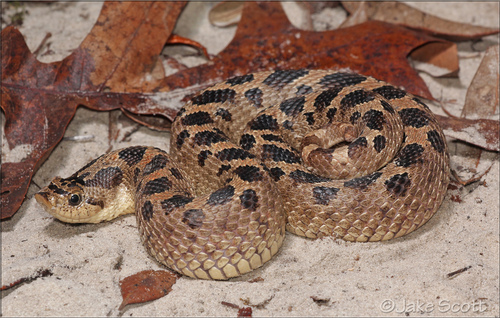
Southern Hognose Snake
Heterodon simus
Meet the 'zombie' of the sandhills—the Southern Hognose Snake is a master of disguise and a champion of dramatic defense. With its adorable upturned snout and quirky personality, this harmless specialist is one of the Southeast's most fascinating and rarest backyard visitors.
Quick Identification
Size
14 to 20 inches (35 to 51 cm) in length; rarely exceeds 24 inches (61 cm)
Colors
Tan, yellowish, or reddish-brown background with a row of dark brown or blackish mid-dorsal blotches; the belly is characteristically pale and lacks dark pigment.
Key Features
- Sharply upturned, shovel-like snout
- Stocky, heavy-bodied build for its length
- Underside of tail is the same pale color as the belly
- Dramatic defensive 'play-dead' behavior
When You’ll See Them
Geographic range
Where Does the Southern Hognose Snake Live?
Native to the North American continent, the Southern Hognose Snake is a regional specialist of the Southeastern United States. Its core range is currently restricted to the Coastal Plain, stretching from southern North Carolina through South Carolina and Georgia, and into parts of Florida and southern Alabama. While historically found in Mississippi, populations there are now extremely rare or potentially extirpated, making this one of the most localized and vulnerable snake species in the American South.
Basemap © OpenStreetMap contributors
Behavior
The Southern Hognose Snake is nature's ultimate drama queen. When confronted by a predator or an curious human, it first attempts to look intimidating by flattening its neck, puffing up its body, and hissing loudly—a performance that earns it nicknames like 'puff adder.' If this bluff doesn't work, the snake transition into a state of thanatosis, or playing dead. It will flip onto its back, let its tongue hang out, and may even secrete a foul-smelling musk to appear as unappetizing as possible.
Beyond its theatrical defense, this snake is a highly specialized and shy creature. It is primarily fossorial, meaning it spends a significant portion of its life underground or buried just beneath the surface of loose, sandy soil. Unlike many other snakes that may be active at night, the Southern Hognose is strictly diurnal, timing its activity to the movements of its favorite prey. Despite their frightening displays, they are entirely harmless to humans and almost never bite, even when handled.
EverydayEarth exclusive
Camera Tips
Capturing a Southern Hognose Snake on camera requires a ground-level approach. Because these snakes are small and hug the earth, position your camera just 2 to 5 inches above the ground. Aim the lens across a known 'travel corridor,' such as the edge of a sandy path or a clearing between clumps of wiregrass. A slight downward angle helps ensure the snake's distinctive upturned snout is visible in the frame.
Since these snakes are toad specialists, the best way to 'bait' a camera is by creating an environment that attracts their prey. A small, shallow water feature or a damp, shady spot near sandy soil will draw in toads, and the snakes will eventually follow the scent. Do not use actual bait or food, as these snakes are strictly hunters of live amphibians. Setting your camera near a 'toad hole' or a patch of loose sand where you see digging marks is a high-percentage strategy.
Timing is everything with this species. They are strictly diurnal and love the sun, so set your camera to be most active during the mid-morning and late afternoon. In the heat of summer, they may only move during the cooler morning hours. Ensure your camera has a high-sensitivity PIR sensor or use 'Time Lapse' mode at 30-second intervals if the snake's slow movement isn't triggering the motion sensor.
Seasonally, look for them in late spring (May and June) when they are searching for mates, or in early autumn when hatchlings emerge. Because they are often well-camouflaged against sandy soil, use a high-resolution setting (4K if available) to help pick out their patterns. If your camera allows for focal adjustment, set it for a close range (3-5 feet) to get the best detail of this relatively small reptile.
Similar Species
Species that look similar or are commonly confused with Southern Hognose Snake.
Frequently Asked Questions
Record Southern Hognose Snake at your habitat
Connect a camera to start building your own species record — AI identifies every visitor automatically.