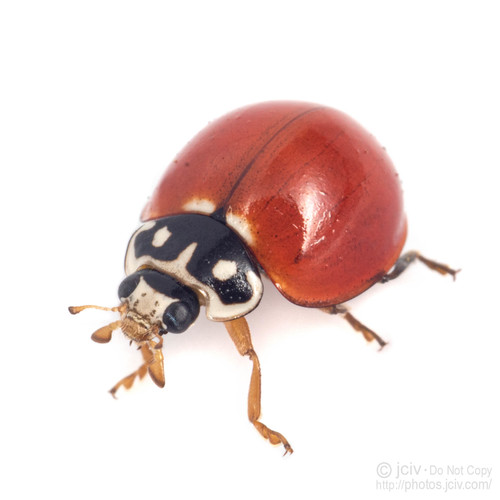
Spotless Lady Beetle
Cycloneda sanguinea
The Spotless Lady Beetle is nature's minimalist predator, identified by its brilliant orange shell and a total lack of spots. A native hero of the Americas, this tiny beetle is a powerhouse of pest control in any backyard garden.
Quick Identification
Size
4 to 5 mm (0.16 to 0.20 inches) in length
Colors
Bright orange to deep red wing covers with no spots; black pronotum with white margins and two distinctive white comma-shaped marks
Key Features
- Solid orange or red wing covers with no black spots
- White 'eye' markings on a black pronotum
- Small, dome-shaped oval body
- Pale white margins on the sides of the thorax
When You’ll See Them
Geographic range
Where Does the Spotless Lady Beetle Live?
The Spotless Lady Beetle is a native inhabitant of the Americas, boasting a vast range that begins in the southern United States and extends through Mexico and Central America. Its territory continues deep into South America, reaching as far south as Argentina and Chile, and it is also commonly found across various Caribbean islands. This species thrives in nearly any environment where its prey is abundant, making it one of the most widespread ladybirds in the Western Hemisphere.
Basemap © OpenStreetMap contributors
Behavior
The Spotless Lady Beetle is a highly active diurnal predator, spending the majority of its day crawling over vegetation in a focused search for aphids. Unlike the invasive Asian Lady Beetle, this native species is less likely to swarm in homes during the winter, preferring to overwinter in small numbers under bark, leaf litter, or stones. They are solitary hunters but can be found in high densities wherever aphid colonies are thriving.
When threatened, these beetles utilize a defensive strategy known as reflex bleeding, secreting a bitter, yellow-colored hemolymph from their leg joints. This fluid is toxic to small predators like birds and ants and serves as a powerful deterrent. In the garden, they are considered a top-tier beneficial insect, often being one of the first predators to arrive when pest populations begin to rise in the spring.
EverydayEarth exclusive
Camera Tips
To capture high-quality images of the Spotless Lady Beetle, you will need a camera capable of macro photography. Because these insects are small and constantly on the move, focus your lens on specific 'trap plants' that are prone to aphids, such as milkweed, roses, or elderberry. Setting your camera on a tripod or using a stabilized mount is essential to avoid blur, especially when zoomed in on a subject only 5mm long.
Position your camera at leaf-level, preferably with the sun behind you to illuminate the glossy orange elytra. Avoid using a direct flash if possible, as the beetle's smooth shell is highly reflective and can create a 'hot spot' that washes out the identifying white marks on the pronotum. If your camera allows for it, use a high shutter speed to freeze the beetle's movement as it explores the underside of leaves.
For the best backyard results, create an 'insect stage' by placing a pot of flowering dill or cilantro in a sunny spot. These plants provide nectar that attracts the beetles, keeping them in one place long enough for a clear shot. Check your camera during the warmest part of the afternoon, as this is when their metabolism is highest and they are most likely to be out in the open rather than hiding in the shade of dense foliage.
Similar Species
Species that look similar or are commonly confused with Spotless Lady Beetle.
Frequently Asked Questions
Record Spotless Lady Beetle at your habitat
Connect a camera to start building your own species record — AI identifies every visitor automatically.