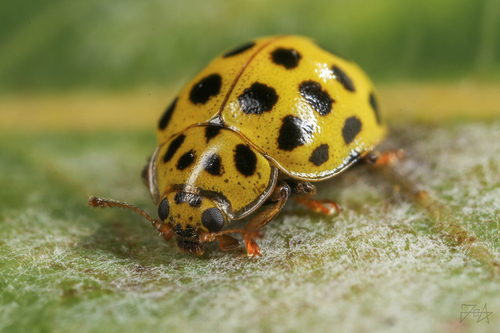
22-spot Ladybird
Psyllobora vigintiduopunctata
The 22-spot ladybird is a bright lemon-yellow gem of the backyard, notable not just for its striking pattern, but for its unique diet of garden fungi. Unlike its aphid-hunting cousins, this tiny beetle spends its life 'mowing' powdery mildew off the leaves of your favorite plants.
Quick Identification
Size
3–5 mm (0.12–0.20 inches) in length
Colors
Bright lemon-yellow wing cases (elytra) with 22 distinct black spots; the pronotum (shield behind the head) is yellow or white with 5 black spots.
Key Features
- 22 circular black spots on bright yellow elytra
- Small, hemispherical body shape
- 5 black spots on a yellow or white pronotum
- Consistently smaller than the common 7-spot ladybird
When You’ll See Them
Geographic range
Where Does the 22-spot Ladybird Live?
The 22-spot ladybird is a widespread resident across the Palearctic region, stretching from the British Isles and across nearly all of Europe into temperate Asia. It is particularly common in the United Kingdom and central Europe, where it thrives in both rural landscapes and suburban garden patches. While it is not native to North America, its range remains stable and robust throughout its native European and Asian territories wherever its specific fungal food sources are present.
Basemap © OpenStreetMap contributors
Behavior
Unlike most members of the ladybird family that are celebrated for hunting aphids, the 22-spot ladybird is a dedicated mycophage, meaning it feeds exclusively on fungi. It spends its days grazing on the powdery mildew that grows on the leaves of various plants, effectively acting as a tiny, yellow lawnmower for fungal hyphae.
These beetles are primarily solitary but can often be found in high densities on a single plant if there is a significant outbreak of mildew. They are non-aggressive and do not bite humans, nor do they damage the plants they inhabit; in fact, their presence is often seen as a beneficial indicator of a diverse garden ecosystem. During the winter, they hibernate (overwinter) in leaf litter, at the base of grass tussocks, or within evergreen foliage.
EverydayEarth exclusive
Camera Tips
Capturing a 22-spot ladybird on camera requires a dedicated macro setup due to their diminutive size. Most standard trail cameras will struggle to focus on an insect only 3mm long, so use an AI-powered camera with a macro lens or a close-focusing attachment. Position your camera just a few inches away from plants showing signs of powdery mildew (look for a white, flour-like dusting on leaves), especially on hogweed, umbellifers, or oak saplings.
Because these ladybirds are active during the warmest parts of the day, ensure your camera is positioned to take advantage of natural light without creating harsh glints on their shiny, domed wing cases. A slight angle (45 degrees) to the leaf surface often works better than a top-down view, as it allows you to capture the characteristic profile and the spots on both the elytra and the pronotum.
Set your camera to a high-speed burst mode or high-frame-rate video. While they move slowly when grazing, they can be surprisingly quick when they decide to fly or drop from a leaf when startled. If you are using a trigger-based system, set the sensitivity to high, though manual time-lapse intervals (one photo every 30 seconds) on a mildew-covered plant is often the most reliable way to catch them in action.
Similar Species
Species that look similar or are commonly confused with 22-spot Ladybird.
Frequently Asked Questions
Record 22-spot Ladybird at your habitat
Connect a camera to start building your own species record — AI identifies every visitor automatically.