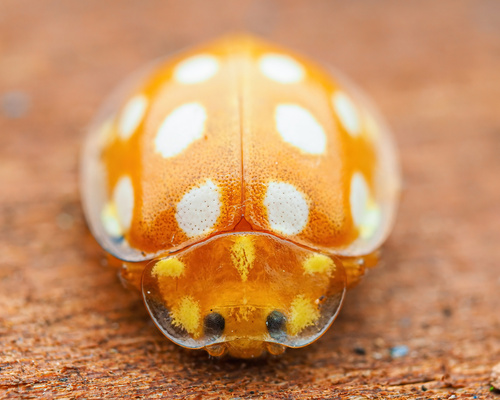
Orange Ladybird
Halyzia sedecimguttata
A luminous garden ally that trades aphids for fungi, the Orange Ladybird is a master of the night. Easily recognized by its 16 white spots and 'glassy' edges, it is a frequent and welcome visitor to backyard trees.
Quick Identification
Size
Small and oval-bodied, typically measuring 5 to 6 mm (0.20 to 0.24 inches) in length.
Colors
Bright orange to orange-yellow base with 16 creamy-white spots (8 on each wing cover). Features a distinctive translucent, glass-like border around the wing covers and head shield.
Key Features
- 16 distinct creamy-white spots on an orange background
- Translucent or 'clear' edges on the elytra and pronotum
- Large, prominent black eyes
- Specialist feeder on powdery mildew rather than aphids
When You’ll See Them
Geographic range
Where Does the Orange Ladybird Live?
The Orange Ladybird is native to the Palearctic region, with a core range stretching across most of Europe and into temperate Asia, including Russia and Japan. In the United Kingdom, it was once considered a rare woodland indicator species, but it has expanded its range significantly over the last few decades into suburban parks and urban gardens. It is now widely distributed from the Mediterranean northwards into Scandinavia, following the prevalence of its favorite deciduous host trees.
Basemap © OpenStreetMap contributors
Behavior
The Orange Ladybird is a fascinating departure from the typical ladybird stereotype. While most of its relatives are famous for devouring aphids, this species is a mycophagous specialist, meaning its diet consists almost entirely of powdery mildew. It spends its life grazing on the fungal coatings that grow on the leaves of deciduous trees, making it a very helpful inhabitant of the garden ecosystem.
Unlike the common Seven-spot Ladybird which basks in the sun, the Orange Ladybird is primarily nocturnal and crepuscular. During the day, it remains hidden on the undersides of leaves to avoid predators and dehydration. As dusk falls, it becomes active, often flying toward artificial light sources. This phototactic behavior makes it one of the most frequent beetle species found near porch lights or window panes at night.
EverydayEarth exclusive
Camera Tips
To capture the Orange Ladybird on an AI-powered camera, you need to change your strategy from traditional wildlife spotting. Because they are attracted to light, the most effective 'bait' is actually a light source. Positioning a camera near an outdoor LED or porch light where insects congregate at night will frequently result in sightings of this beetle as it crawls across the illuminated surfaces.
Since these beetles are quite small (only 5-6mm), your camera needs to be mounted very close to the target surface—ideally within 6 to 12 inches—to get a clear identification. If you are using a camera with a fixed focus, look for models with macro capabilities. Aiming your camera at the trunk or lower branches of a Sycamore or Ash tree during the summer months is also a great strategy, as these are their primary feeding grounds. Look for leaves with white, dusty patches of mildew, as these are the ladybird's dinner plates.
When reviewing footage, look for the 'glow.' The Orange Ladybird's translucent edges can catch the light of an infrared flash in a way that makes them look slightly luminous. If your camera settings allow for it, reduce the IR flash intensity to prevent 'white-out' on their reflective wing covers. In late autumn, you can also place cameras near ivy-covered walls or wooden fences, where they often gather in small groups to overwinter in crevices.
Similar Species
Species that look similar or are commonly confused with Orange Ladybird.
Frequently Asked Questions
Record Orange Ladybird at your habitat
Connect a camera to start building your own species record — AI identifies every visitor automatically.