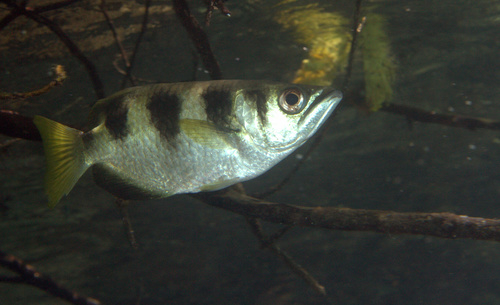
Banded Archerfish
Toxotes jaculatrix
Meet the marksman of the mangroves, a fish that uses a high-pressure water jet as a literal 'sniper rifle' to hunt insects. The Banded Archerfish is a master of physics, calculating light refraction to knock prey out of the air with surgical precision.
Quick Identification
Size
15 to 25 cm (6 to 10 inches) in length; weight typically ranges from 150 to 450 grams (5 to 16 ounces).
Colors
Shimmering silvery-white or greenish-yellow body with 4 to 5 prominent black, semi-triangular bands across the upper half of the body.
Key Features
- Specialized mouth groove for spitting water
- Large eyes positioned near the top of the head for surface vision
- Dorsal fin set far back toward the tail
- Flattened body shape optimized for looking upward
When You’ll See Them
Geographic range
Where Does the Banded Archerfish Live?
Native to the vast Indo-Pacific region, the Banded Archerfish is a common sight along the tropical coastlines of Southeast Asia and Northern Australia. Its core range includes the brackish waters of India, Thailand, the Philippines, and Indonesia, extending eastward toward the Solomon Islands. These fish thrive in the complex root systems of mangrove forests where the land and sea meet, though they are occasionally found in freshwater rivers quite far inland.
Basemap © OpenStreetMap contributors
Behavior
The Banded Archerfish is world-renowned for its sophisticated hunting technique, which involves firing a high-pressure jet of water at terrestrial insects on overhanging branches. By pressing its tongue against a groove in the roof of its mouth and suddenly contracting its gill covers, it can shoot a stream of water up to 3 meters away with startling accuracy. These fish are capable of compensating for the refraction of light at the water's surface, a complex calculation that most animals cannot perform.
In their social lives, Banded Archerfish are generally peaceful shoalers that travel in small groups. They are highly competitive when feeding; as soon as an insect is hit by a water jet, the fish will leap toward the spot where the prey is expected to land, often reaching it within 50 milliseconds. Interestingly, younger archerfish learn the art of 'sharpshooting' by observing older, more experienced members of the school, though they must practice extensively to perfect their aim.
EverydayEarth exclusive
Camera Tips
To capture the Banded Archerfish's incredible spitting behavior, camera placement is everything. If you have a backyard pond or live on a coastal property with mangroves, mount your camera approximately 2 to 3 feet above the water line, angled downward at a 45-degree angle. This perspective allows you to see both the fish at the surface and the potential prey on overhanging branches. Using an AI-powered camera with high-speed triggers is essential, as the entire hunting sequence—from the spit to the strike—happens in a fraction of a second.
For the best results, use a 'bait' strategy by hanging a small basket of mealworms or fruit flies about 12 to 18 inches above the water's surface within the camera's field of view. The presence of live, moving insects will trigger the archerfish's natural hunting instinct. Ensure your camera is set to its highest possible frame rate (at least 60fps, but 120fps is ideal) to capture the water jet in mid-air. Lighting can be tricky on the water; try to position the camera so the sun is behind it to minimize glare and highlight the silvery sheen of the fish's scales.
If you are using an underwater housing or a specialized pond camera, consider a 'split-shot' setup where the lens is half-submerged. This provides a stunning view of the archerfish looking upward from below while showing the 'target' above. Because they are most active during the brightest parts of the day when insects are moving, you won't need infrared night vision, but a polarizing filter can be a game-changer to help the camera see through the water's surface tension.
Similar Species
Species that look similar or are commonly confused with Banded Archerfish.
Frequently Asked Questions
Record Banded Archerfish at your habitat
Connect a camera to start building your own species record — AI identifies every visitor automatically.