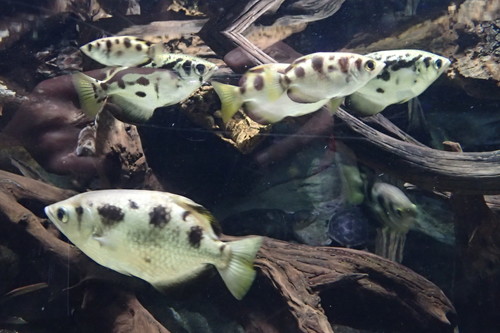
Smallscale Archerfish
Toxotes microlepis
Meet the precision marksman of the Mekong. The Smallscale Archerfish uses high-pressure water jets to knock insects out of the air with uncanny accuracy.
Quick Identification
Size
Typically 10-13 cm (4-5 inches), reaching a maximum length of 15 cm (5.9 inches).
Colors
Silver to pale gold iridescent body with 4-5 dark, wedge-shaped vertical bands on the upper half; fins are often translucent with subtle yellowish or dusky margins.
Key Features
- Extremely small scales compared to other archerfish species
- 4 to 5 dark, triangular bands along the back
- Large, upward-pointing mouth designed for surface feeding
- Compressed, deep-bodied silver profile
When You’ll See Them
Geographic range
Where Does the Smallscale Archerfish Live?
Native to the lush tropical regions of the Indo-Pacific, the Smallscale Archerfish is a quintessential Southeast Asian species. Its core populations are concentrated within the massive Mekong and Chao Phraya river systems, spanning through Thailand, Cambodia, Laos, and Vietnam. Beyond the mainland, they are commonly found in the riverine environments of the Malay Peninsula and the Greater Sunda Islands, including Sumatra and Borneo.
Basemap © OpenStreetMap contributors
Behavior
The Smallscale Archerfish is a master of hydro-ballistics, famous for its ability to "shoot" down terrestrial insects from overhanging branches. By pressing its tongue against a groove in the roof of its mouth and quickly closing its gill covers, it creates a high-pressure jet of water that can travel several feet. What makes this behavior truly remarkable is the fish's ability to account for light refraction at the water's surface, adjusting its aim to hit the actual location of the insect rather than its visual ghost.
In their natural environment, these fish are social and often swim in small groups, scouting the water's edge for movement. While they are highly specialized hunters, they are also opportunistic and will leap out of the water to grab low-hanging prey if the "spitting" method isn't required. They are generally peaceful toward humans but can be quite shy, quickly darting into deeper water or submerged roots if they perceive a shadow or vibration from the bank.
EverydayEarth exclusive
Camera Tips
To capture the Smallscale Archerfish on camera, you need to focus on the interface between water and air. Use an underwater action camera or a waterproof trail camera mounted just 2-3 inches below the surface. Position the camera at a 45-degree upward angle toward a known perching spot for insects, such as a low-hanging branch or a dock piling. This setup allows you to catch the fish as it enters the frame to take its shot.
Using a lure is highly effective for this species. You can use a small piece of wood or a plastic leaf with a bit of honey or a live mealworm attached to it, positioned about 12 inches above the water's surface within the camera's focus range. The archerfish will be drawn to the movement or the scent, and you are likely to record the spectacular moment they fire their water jet to dislodge the bait.
Lighting is the most critical factor for clear aquatic footage. Try to set up your camera in an area that gets bright, indirect sunlight. If you are recording from above the water, use a circular polarizing filter on your lens to cut through the surface glare and reflections. This will allow your AI camera to identify the fish's silver body and dark bands through the water much more effectively. Early morning is often best, as the water surface is usually at its calmest.
Similar Species
Species that look similar or are commonly confused with Smallscale Archerfish.
Frequently Asked Questions
Record Smallscale Archerfish at your habitat
Connect a camera to start building your own species record — AI identifies every visitor automatically.