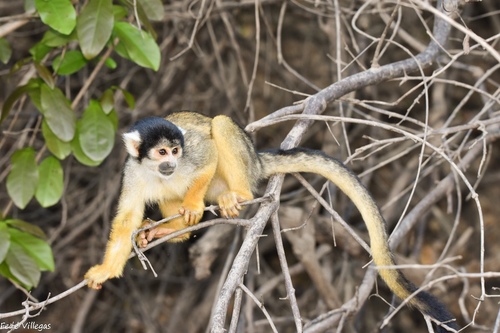
Black-capped Squirrel Monkey
Saimiri boliviensis
The Black-capped Squirrel Monkey is the energetic acrobat of the Amazonian canopy, known for its striking dark crown and vibrant social life. Living in massive, female-led troops, these small primates bring the rainforest to life with their constant chirping and agile leaps.
Quick Identification
Size
Head-body length of 22-37 cm (8.8-14.6 in) with a tail up to 40 cm (15.7 in); weight ranges from 365-1,135 g (0.8-2.5 lbs).
Colors
Greyish-gold body with yellow-orange forearms and feet; distinctive black or dark brown crown (cap) and white mask around the eyes.
Key Features
- Dark black or chocolate brown cap on the head
- Bright white fur surrounding the eyes and ears
- Long, slender tail with a black bushy tip
- Yellowish-orange tint on the lower limbs and paws
When You’ll See Them
Geographic range
Where Does the Black-capped Squirrel Monkey Live?
The Black-capped Squirrel Monkey is a native of the South American continent, specifically inhabiting the lush landscapes of the upper Amazon basin. Its core population is found across northern and central Bolivia, eastern Peru, and western Brazil. These monkeys are primarily found in lowland forests but are highly adaptable to various wooded environments as long as there is a steady supply of water and fruit-bearing trees.
Basemap © OpenStreetMap contributors
Behavior
During the day, the troop is a constant blur of motion as they leap between branches with remarkable agility. They are primarily diurnal, beginning their foraging at dawn and resting during the hottest part of the midday. They communicate through a sophisticated vocabulary of chirps, peeps, and squawks to coordinate movement and alert the group to predators like eagles or snakes. While generally shy, they can become quite bold if they live near human-occupied areas where food is easily accessible.
EverydayEarth exclusive
Camera Tips
Because these primates are incredibly fast and constantly twitching, a fast trigger speed is non-negotiable. Set your camera to a 'Burst' or 'Multi-shot' mode with at least 3-5 photos per trigger, or better yet, record in 4K video. This ensures you catch the split-second leaps and social grooming behaviors that define the species. Be mindful of the high-contrast lighting in the rainforest; try to position the camera so it isn't facing directly into the bright canopy gaps which can cause silhouette effects.
If you are setting up a camera near a residence or plantation, focus on fruiting trees like wild figs or palms. These are natural magnets for the troop. Squirrel monkeys are famously curious and may investigate your gear; use a heavy-duty security box and ensure all straps are tucked away so they don't get chewed on. Since they are strictly diurnal, you can save battery life by setting the camera to be active only during daylight hours.
Similar Species
Species that look similar or are commonly confused with Black-capped Squirrel Monkey.
Frequently Asked Questions
Record Black-capped Squirrel Monkey at your habitat
Connect a camera to start building your own species record — AI identifies every visitor automatically.