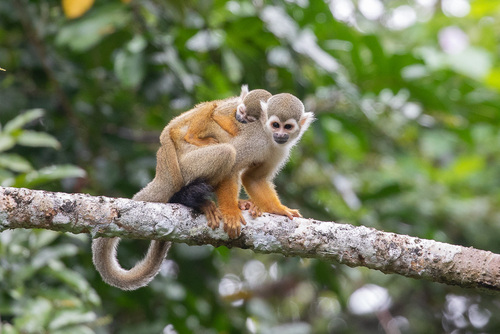
Common Squirrel Monkey
Saimiri sciureus
A social powerhouse of the Amazonian canopy, the Common Squirrel Monkey is easily recognized by its 'death's head' facial mask and vibrant orange limbs. Living in massive troops, these intelligent primates turn the forest into a high-speed playground.
Quick Identification
Size
Body length 25–32 cm (10–13 in), tail length 35–42 cm (14–17 in); weight 750–1,100g (1.7–2.4 lbs)
Colors
Greyish-olive or greenish-brown torso, white underside, white 'mask' around eyes with a black muzzle, and distinct yellow-to-orange fur on the forearms, hands, and feet.
Key Features
- Distinctive white 'mask' around eyes and black muzzle
- Yellow or orange-tinted fur on limbs
- Long, slender tail with a black bushy tip (non-prehensile)
- Large, social troops often exceeding 40 individuals
When You’ll See Them
Geographic range
Where Does the Common Squirrel Monkey Live?
Native to the lush tropical heart of South America, the Common Squirrel Monkey is a quintessential inhabitant of the Amazon Basin and the Guiana Shield. Their core territory stretches across Brazil, Colombia, French Guiana, Guyana, Suriname, and Venezuela, where they favor dense forest canopies often located near rivers or flooded forests. While they are primarily lowland specialists, their adaptable nature allows them to thrive in primary rainforests, secondary growth areas, and even coastal mangroves.
Basemap © OpenStreetMap contributors
Behavior
Common Squirrel Monkeys are exceptionally social primates that spend the vast majority of their lives in the forest canopy. They move in large, multi-male/multi-female troops that can number up to 100 individuals, though smaller groups of 20 to 50 are more common. These monkeys are highly vocal, using a complex repertoire of chirps, peeps, and squawks to coordinate movement, sound alarms, and maintain social bonds. Unlike many other New World monkeys, their long tails are not prehensile and are used primarily for balance rather than gripping branches.
During the day, the troop follows a structured routine of foraging, traveling, and social grooming. They are remarkably agile, capable of leaping several meters between branches with ease. While they are generally wary of humans in the wild, populations near eco-lodges or forest-edge communities can become habituated to human presence, occasionally raiding gardens or fruit trees. They are most active in the middle-to-lower canopy layers where insects and fruit are most abundant.
EverydayEarth exclusive
Camera Tips
To capture these agile primates on camera, you must focus on the 'arboreal highways' they use to navigate the forest. Look for horizontal branches that bridge gaps between large trees, approximately 3 to 6 meters (10–20 feet) above the ground. If you are setting up in a backyard or garden near a forest edge, mount your camera on a sturdy trunk angled slightly downward toward a known fruit-bearing tree or a consistent water source, as they descend to lower levels to drink during the dry season.
Because Common Squirrel Monkeys move with incredible speed and fluidity, camera settings are critical. Use a fast shutter speed (at least 1/500s) if your camera allows manual overrides, or select a 'Sports' or 'Action' mode to prevent motion blur. Enable burst mode or 'multi-shot' because where there is one squirrel monkey, there are dozens; a single trigger might miss the lead scout but catch the bulk of the troop following behind. High-sensitivity PIR sensors are preferred to catch their rapid movements across the frame.
While we generally discourage feeding wildlife, you can attract them to a specific 'photo zone' by providing a shallow, elevated water basin during dry spells or by planting native fruit trees like figs or palms. If using a lure, fresh bananas or mangoes placed in a secure, elevated basket can keep a troop in front of the lens for several minutes, allowing for high-quality video or detailed stills of their social interactions and grooming behaviors.
Similar Species
Species that look similar or are commonly confused with Common Squirrel Monkey.
Frequently Asked Questions
Record Common Squirrel Monkey at your habitat
Connect a camera to start building your own species record — AI identifies every visitor automatically.