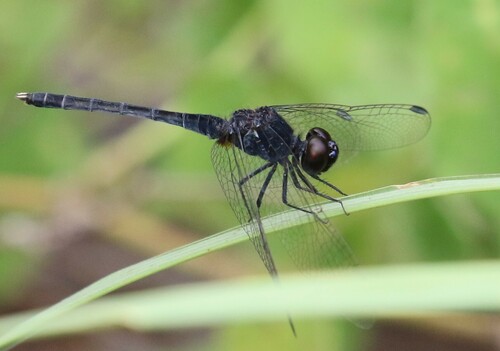
Black Percher
Diplacodes lefebvrii
A small but striking master of the low-profile hunt, the Black Percher is easily identified by its charcoal-black body and preference for sun-warmed rocks. It is a frequent visitor to backyard ponds across Africa and southern Eurasia, serving as a natural controller of garden pests.
Quick Identification
Size
Length 25–35 mm (1–1.4 in); wingspan 40–55 mm (1.6–2.2 in)
Colors
Mature males are uniform charcoal to jet black; females and juveniles are sandy-brown or yellowish with dark side-markings.
Key Features
- Solid black body in mature males
- Habit of perching on bare ground or flat rocks
- Small dark patches at the base of the hindwings
- Clear wings with black pterostigma (wing spots)
When You’ll See Them
Geographic range
Where Does the Black Percher Live?
The Black Percher is a highly successful traveler with a range that covers almost the entire African continent and extends into southern Eurasia. It is a common sight from the Mediterranean basin through the Middle East and into India, with established populations in southern European countries like Spain, Portugal, and Turkey. This species is remarkably adaptable, flourishing in both tropical wetlands and semi-arid regions wherever permanent or seasonal freshwater can be found.
Basemap © OpenStreetMap contributors
Behavior
The Black Percher is a bold, territorial dragonfly that earns its name from its distinctive habit of resting on low-lying surfaces. Unlike many other dragonflies that prefer high reeds or branches, this species is frequently found on sun-warmed rocks, dirt paths, or even concrete near water sources. Males are particularly territorial, selecting a prime 'perch' and aggressively defending it against other males by darting out in high-speed aerial skirmishes before returning to the exact same spot.
As active hunters, they rely on their exceptional vision to spot movement. When they aren't defending their territory, they are scanning the air for small insects. Their flight is characterized by short, jerky bursts rather than long sustained glides. Because they are cold-blooded, they are highly dependent on the sun; you will often see them adjusting their wing position or body angle to maximize heat absorption from the surface they are sitting on.
EverydayEarth exclusive
Camera Tips
To successfully capture the Black Percher on your backyard camera, you must think low. Because these dragonflies prefer perching on the ground or flat stones, a standard eye-level camera placement will likely miss them. Position your camera on a mini-tripod just a few inches off the ground, or mount it near the edge of a garden pond. Angle the lens slightly upward to catch the detail of their wings against the light, or point it directly at a flat 'sun-trap' rock where you have seen them landing previously.
Lighting is the most critical factor for this species. Black Perchers are most active when the sun is at its zenith, and their dark bodies can be difficult for AI sensors to distinguish in deep shadows. Place your camera in a spot that receives full, direct sunlight for several hours. This not only ensures the dragonfly will want to perch there to warm up, but the bright light will also allow for the high shutter speeds necessary to freeze their rapid movements and wing beats.
Since you cannot bait dragonflies with food, you must bait them with habitat. Placing a dark-colored, flat slate or a piece of terracotta tile in a sunny spot near water creates an irresistible perching platform. If your camera has a 'pro-capture' or 'pre-roll' feature, enable it; dragonflies take off and land in the blink of an eye, and these settings help ensure you don't just end up with a photo of an empty rock. Set your motion sensitivity to 'High' and focus on a small detection zone specifically around your 'bait' rock to avoid false triggers from swaying grass.
Similar Species
Species that look similar or are commonly confused with Black Percher.
Frequently Asked Questions
Record Black Percher at your habitat
Connect a camera to start building your own species record — AI identifies every visitor automatically.