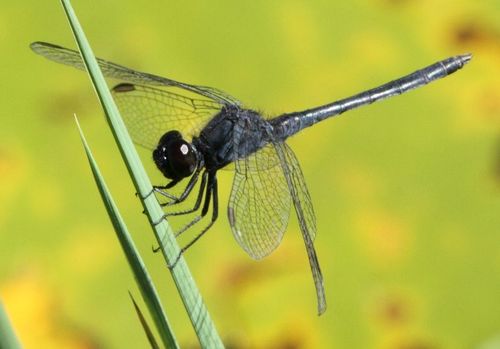
Dwarf Percher
Diplacodes pumila
The Dwarf Percher is one of Africa's smallest and most elusive dragonflies, a charcoal-colored master of the savanna's grassy wetlands. Though tiny, its precision as an aerial hunter makes it a fascinating subject for backyard wildlife enthusiasts.
Quick Identification
Size
18-22 mm (0.7-0.9 inches) in length; wingspan of 35-42 mm (1.4-1.6 inches)
Colors
Mature males are dark charcoal-grey to black; females and juveniles are yellowish-brown with dark abdominal stripes
Key Features
- Diminutive size, among the smallest dragonflies in Africa
- Mature males have a dark, almost black pruinose body
- Clear wings with small amber or yellowish spots at the base
- Distinctly black legs and dark wing spots (pterostigmata)
When You’ll See Them
Geographic range
Where Does the Dwarf Percher Live?
The Dwarf Percher is native to the African continent, primarily concentrated across the southeastern and central regions. Its core population spans from South Africa and Mozambique in the south, reaching northward through Zimbabwe, Zambia, and Tanzania, and extending into the Democratic Republic of the Congo. It is a specialist of Afrotropical wetlands, thriving specifically where grassy savanna meets permanent or seasonal water sources.
Basemap © OpenStreetMap contributors
Behavior
The Dwarf Percher is a sun-loving dragonfly known for its habit of 'perching' for long periods on low-lying vegetation. Unlike larger dragonflies that aggressively patrol wide territories, this species is more sedentary. It spends much of its day resting on a blade of grass or a reed, occasionally darting out in a rapid, circular flight to snatch a tiny insect from the air before returning to the exact same spot.
Despite their small size, they are quite hardy and can be found in relatively high densities around suitable water sources. They are most active during the heat of the day, using the sun's energy to power their flight muscles. Because they stay so low to the ground—often just inches above the water or soil—they are frequently overlooked by casual observers, blending in perfectly with the shadows of the grass.
EverydayEarth exclusive
Camera Tips
Capturing the Dwarf Percher on an AI camera requires a ground-level strategy. Because these insects rarely fly higher than knee-height, you should mount your camera on a small tripod or stake only 15-30 centimeters (6-12 inches) above the ground. Direct the lens toward the tips of vertical grasses or reeds at the edge of a pond or marshy area, as these are their preferred hunting lookouts. A camera with a dedicated macro mode or a very close focal point is necessary to resolve the details on such a tiny subject.
Lighting is the most critical factor for a clear shot. Position your camera so the sun is behind it or to the side; this will illuminate the dark, matte-black body of the male and prevent the wings from disappearing into a silhouette. Since dragonflies are ectothermic, they will be most active and present on their perches during the warmest parts of the day. If your camera allows for high-frame-rate video, use it to capture the incredible mechanics of their four-winged flight as they take off to hunt.
To attract them to a specific spot for your camera, you don't need food; you need the perfect 'throne.' Placing a few dry, upright sticks or bamboo stakes in a sunny, shallow water feature can provide an irresistible perching spot. Ensure the background is as distant as possible to create a soft blur (bokeh), which helps the small, dark dragonfly stand out against the busy green environment of the marsh.
Similar Species
Species that look similar or are commonly confused with Dwarf Percher.
Frequently Asked Questions
Record Dwarf Percher at your habitat
Connect a camera to start building your own species record — AI identifies every visitor automatically.