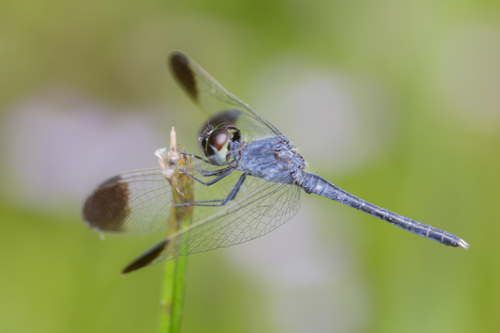
Charcoal-winged Percher
Diplacodes nebulosa
A tiny, velvety-black jewel of the wetlands, the Charcoal-winged Percher is famous for its distinctive dark wing tips. Often found guarding its territory from a single blade of grass, this small dragonfly is a master of the marsh.
Quick Identification
Size
Length: 20-25 mm (0.8-1 in); Wingspan: 40-45 mm (1.6-1.8 in)
Colors
Mature males are velvety black with distinctive dark charcoal-to-black patches at the tips of all four wings. Females and immature males are ochre-yellow with black abdominal markings and lack the dark wing tips.
Key Features
- Smallest black dragonfly in its range
- Distinct charcoal-colored patches at wing tips in males
- Velvety black thorax and abdomen
- Wings held forward and downward when perched
When You’ll See Them
Geographic range
Where Does the Charcoal-winged Percher Live?
Where Does the Charcoal-winged Percher Live? This small dragonfly is a staple of the wetlands across the Indo-Australian region. Its native range begins in the Indian subcontinent and stretches across Southeast Asia, including Thailand, Vietnam, and Malaysia, reaching northward into Southern China. It is also a common sight in the tropical northern reaches of Australia and throughout the Indonesian archipelago, thriving in any lowland area where warm, stagnant water is present.
Basemap © OpenStreetMap contributors
Behavior
The Charcoal-winged Percher is a classic 'percher' dragonfly, spending the majority of its day sitting atop aquatic vegetation or reeds. They are known for their site fidelity, often returning to the exact same blade of grass even after being disturbed or successfully darting out to catch prey. Unlike larger, more aggressive dragonflies that patrol large territories in flight, this species prefers to stay low to the ground or water surface, making them somewhat difficult to spot despite the male's dark coloration.
These insects are highly territorial on a micro-scale. A single male will guard a small patch of marshland, chasing away other males of the same species. Their flight is short and jerky, designed for quick aerial interceptions rather than long-distance travel. To humans, they are entirely harmless and serve as excellent natural pest controllers, as they spend their lives reducing the local population of small biting flies and gnats.
EverydayEarth exclusive
Camera Tips
To successfully capture the Charcoal-winged Percher on camera, you must focus on 'perch management.' Because these dragonflies return to the same twig repeatedly, identify a prominent, upright reed or stick near the water's edge. Position your camera on a tripod or mount at a height of about 1 to 3 feet from the ground, focusing manually on the tip of the perch. Using a macro lens or a camera with a short minimum focusing distance is essential, as these dragonflies are quite small.
Lighting is the biggest challenge when filming the Charcoal-winged Percher. The male's velvety black body absorbs light, which can lead to a 'black blob' effect in photos. Aim for a side-lighting setup where the sun hits the dragonfly at a 45-degree angle; this will highlight the texture of the thorax and the iridescent veins in the wings, while also making the charcoal wing-tips stand out against the background. Early morning or late afternoon sun provides the warmest, most flattering light, though the insects are most active in the midday heat.
If using an AI-powered trail camera, set it to its highest motion sensitivity and use the shortest possible trigger delay. Since dragonflies move extremely fast, a slow trigger will result in many empty frames. If you are trying to attract them to a specific spot for a camera setup, ensure there is no tall competing vegetation nearby—they prefer the tallest 'lookout' in their immediate vicinity. Avoid using any chemical lures; instead, a clean, still water feature with a few well-placed bamboo stakes will act as a natural magnet for this species.
Similar Species
Species that look similar or are commonly confused with Charcoal-winged Percher.
Frequently Asked Questions
Record Charcoal-winged Percher at your habitat
Connect a camera to start building your own species record — AI identifies every visitor automatically.