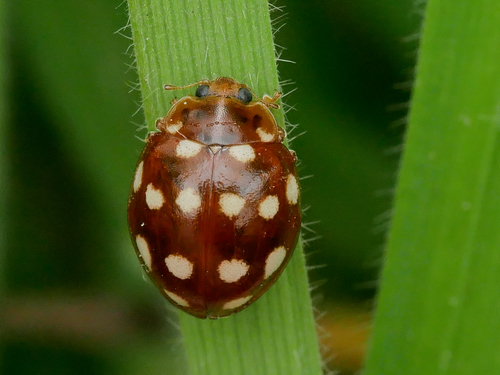
Cream-spotted Ladybird
Calvia quatuordecimguttata
A maroon-colored gem of the canopy, the Cream-spotted Ladybird is a master aphid hunter. With 14 elegant pale spots, this tiny beetle is a favorite find for backyard naturalists.
Quick Identification
Size
4 to 5 mm (0.16 to 0.20 inches) in length
Colors
Rich maroon or orange-brown elytra with 14 distinct cream-colored spots; legs and antennae are pale brown
Key Features
- 14 distinct cream-colored spots
- Maroon to orange-brown base color
- Small oval body, 4-5mm long
- Pale brownish legs
When You’ll See Them
Geographic range
Where Does the Cream-spotted Ladybird Live?
The Cream-spotted Ladybird enjoys a massive Holarctic distribution, making it a familiar sight across the Northern Hemisphere. It is native to most of Europe, including the United Kingdom, and extends eastward through Russia and Central Asia all the way to Japan. In North America, its range covers much of the northern United States and Canada, where it thrives in temperate woodland and suburban environments.
Basemap © OpenStreetMap contributors
Behavior
In the autumn, they exhibit a fascinating overwintering behavior. Rather than migrating long distances, they seek out cracks in tree bark, dense ivy, or leaf litter to enter a state of dormancy. While they are generally solitary during the breeding season, you may occasionally find small clusters of them huddled together in sheltered spots to survive the frost. They are beneficial to humans as biological pest controllers and are completely harmless to handle.
EverydayEarth exclusive
Camera Tips
To capture the Cream-spotted Ladybird on camera, you will need a device capable of macro photography or a lens with a very short minimum focus distance. Because they are only about 5mm long, standard trail cameras will usually produce a blur unless they are specifically designed for close-up insect work. Focus your efforts on the underside of leaves or along the stems of deciduous trees like Lime, Sycamore, or Ash, where aphid colonies are present.
Placement is key; try mounting your camera on a stable branch or using a tripod to focus on a specific 'hunting ground'—look for leaves with shiny, sticky honeydew, which is a tell-tale sign of aphids and their ladybird predators. The best time for filming is between 10 AM and 4 PM on warm, sunny days. The direct sunlight not only provides the light needed for a sharp macro image but also provides the heat the ladybirds need to be active.
Avoid using a harsh flash if possible, as the ladybird's elytra (wing covers) are highly reflective and can cause a 'blown out' white spot on your image that obscures the cream markings. Instead, use a diffuser or rely on natural, indirect sunlight. If your camera allows for it, use a high shutter speed to freeze their movement, as they can crawl quite rapidly when they are on the hunt. In late autumn, shift your camera focus to tree trunks and ivy-covered walls where they may be looking for overwintering sites.
Similar Species
Species that look similar or are commonly confused with Cream-spotted Ladybird.
Frequently Asked Questions
Record Cream-spotted Ladybird at your habitat
Connect a camera to start building your own species record — AI identifies every visitor automatically.