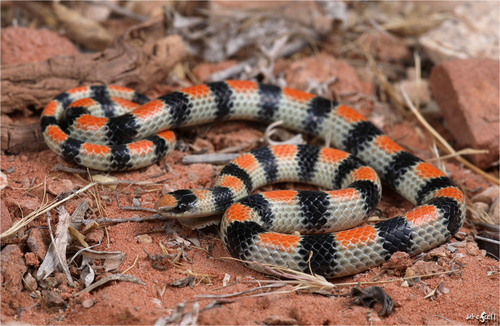
Ground Snake
Sonora semiannulata
The Ground Snake is the 'living kaleidoscope' of the desert floor, appearing in an incredible array of colors and patterns. Small, harmless, and incredibly secretive, this burrowing specialist is a fascinating find for any backyard nature enthusiast.
Quick Identification
Size
20-48 cm (8-19 inches) in length; very slender body profile.
Colors
Highly polymorphic; colors range from gray and brown to orange and red. Patterns can be solid, striped with a single dorsal line, or vividly banded with black.
Key Features
- Highly variable coloration and patterns
- Smooth, shiny scales
- Dark, crown-like 'miter' marking on the head
- Small, slender build usually under 12 inches
When You’ll See Them
Geographic range
Where Does the Ground Snake Live?
Native to North America, the Ground Snake is primarily found across the Western and Southwestern United States, extending from California and Oregon eastward to Missouri and Texas. Its range continues southward into Northern and Central Mexico, where it thrives in diverse arid and semi-arid environments. This species is a true specialist of the American West, favoring regions where the soil is loose enough for burrowing and the climate provides warm summer nights.
Basemap © OpenStreetMap contributors
Behavior
The Ground Snake is a master of camouflage and secrecy, spending much of its life tucked away under rocks, debris, or within loose soil. Despite their small size, they are active hunters of the undergrowth, emerging primarily at night or during the cooler twilight hours of dawn and dusk to forage for small invertebrates. Because they are so secretive, they are rarely seen by casual observers unless a rock is overturned or they are forced out by heavy rains.
When encountered, these snakes are remarkably docile. They lack any form of venom and rarely even attempt to bite, instead relying on their cryptic patterns to blend into the earth or performing quick, erratic movements to confuse a predator. In the backyard, they are excellent neighbors that help control populations of scorpions and spiders without posing any threat to pets or humans.
EverydayEarth exclusive
Camera Tips
Capturing a Ground Snake on camera requires a specialized approach because of their small size and low-profile lifestyle. Standard trail cameras mounted on trees will likely miss them entirely. Instead, place your camera at ground level, ideally using a macro-lens attachment or a camera with a short focal distance. Positioning the lens just 2 to 3 inches off the ground, angled slightly downward toward a 'choke point' like the edge of a large flat rock or a gap in a garden border, will yield the best results.
Since these snakes are attracted to moisture and prey, setting up your camera near a leaky outdoor faucet or a consistently damp patch of mulch can increase your chances. You don't need traditional bait, but creating a 'refugium'—a flat piece of plywood or a large piece of bark placed on the ground—will encourage them to settle in the area. Position the camera to trigger when they emerge from beneath this cover during the late evening hours.
Timing is critical for the Ground Snake. They are most active on warm, humid nights, particularly after a light rain shower which brings their invertebrate prey to the surface. Set your camera to 'Burst Mode' or high-speed video, as these snakes can move surprisingly fast when they aren't foraging. Use a high-sensitivity PIR (Passive Infrared) setting if your camera allows it, as their small body mass generates very little heat against the ground background, making them difficult for standard sensors to detect.
Similar Species
Species that look similar or are commonly confused with Ground Snake.
Frequently Asked Questions
Record Ground Snake at your habitat
Connect a camera to start building your own species record — AI identifies every visitor automatically.