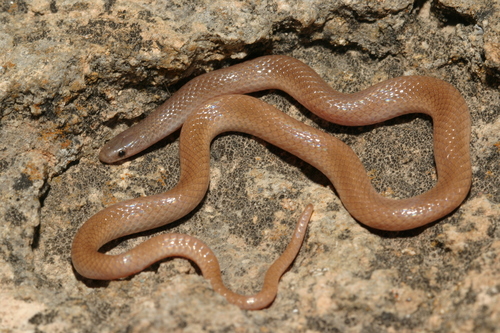
Flat-headed Snake
Tantilla gracilis
The Flat-headed Snake is a miniature marvel of the undergrowth, often mistaken for an earthworm at first glance. This docile, pink-bellied resident is a master of disguise and a helpful ally in the garden.
Quick Identification
Size
18–24 cm (7–9.5 inches) in length; extremely slender profile.
Colors
Uniform tan, light brown, or reddish-gray upper body; salmon-pink or pale reddish belly.
Key Features
- Flattened head slightly darker than the rest of the body
- Smooth, glossy scales
- Vibrant salmon-colored belly
- Small, bead-like eyes and slender 'pencil-thin' build
When You’ll See Them
Geographic range
Where Does the Flat-headed Snake Live?
This diminutive serpent is a native of the South-Central United States, where it thrives in the warm transition zones between the Great Plains and the Eastern Woodlands. Its core population density is found throughout Texas, Oklahoma, Arkansas, and Missouri, extending slightly into parts of Kansas, Louisiana, and Illinois. Because they are so small and cryptic, they often go unnoticed in these regions even in well-established residential neighborhoods and urban parks.
Basemap © OpenStreetMap contributors
Behavior
The Flat-headed Snake is one of the most secretive reptiles in North America, spending the vast majority of its life underground or hidden beneath surface debris. Despite being quite common in certain regions, they are rarely seen by the casual observer because they rely on their fossorial nature to avoid predators. They are exceptionally docile and almost never bite when handled, instead preferring to wiggle vigorously to escape back into the soil.
These snakes are solitary hunters that specialize in finding prey in the tight crevices of the earth. While they are technically mildly venomous to their tiny prey, they are completely harmless to humans and lack the delivery system or potency to pose any risk. In suburban environments, they are often found in flower beds or under patio stones, where they provide excellent natural pest control by eating small invertebrates.
EverydayEarth exclusive
Camera Tips
Capturing a Flat-headed Snake on camera requires a specialized approach because of their tiny size and habit of staying under cover. Standard trail cameras mounted on trees will likely miss them entirely. Instead, use a macro-capable camera or an AI-powered backyard camera placed at ground level. Position the lens just 2 to 4 inches off the ground, angled slightly downward toward a high-traffic area like the edge of a flat rock or a gap in a garden retaining wall where they might emerge to hunt at twilight.
Since these snakes are attracted to moisture and the prey that lives within it, placing your camera near a damp, mulched flower bed after a light spring rain is your best bet. You can create a 'funnel' effect by placing two small logs or rows of bricks in a V-shape that leads directly in front of the camera lens. This encourages the snake to crawl through the narrow opening where your sensor is focused. Avoid using traditional baits; instead, focus on providing the perfect micro-habitat—a flat, sun-warmed rock near some damp soil.
Because they are so slender, ensure your camera's PIR (Passive Infrared) sensor is set to its highest sensitivity, or use a camera with 'time-lapse' mode during the early evening hours. If your camera has a focal adjustment, set it to the minimum distance. These snakes move with a quick, jerky motion, so a high frame rate or fast shutter speed is essential to prevent a blurry tan line from being the only thing you capture. Late spring evenings, when the ground is warm but the air is cooling, provide the ideal thermal contrast for detection.
Similar Species
Species that look similar or are commonly confused with Flat-headed Snake.
Frequently Asked Questions
Record Flat-headed Snake at your habitat
Connect a camera to start building your own species record — AI identifies every visitor automatically.