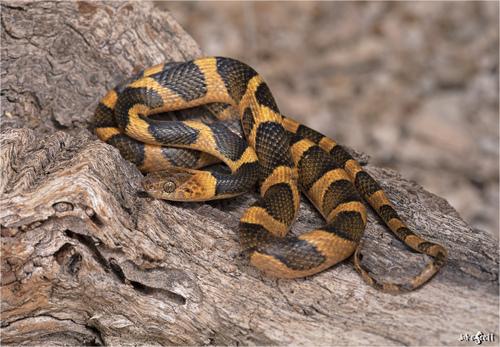
Northern Cat-eyed Snake
Leptodeira septentrionalis
A nocturnal specialist with striking 'cat-like' eyes, the Northern Cat-eyed Snake is a master of the tropical night. Found from Texas to Costa Rica, this mildly venomous but gentle climber is a fascinating visitor to backyard ponds and forest edges.
Quick Identification
Size
18 to 39 inches (46 to 100 cm) in length; slender body with a distinct neck.
Colors
Cream or tan background with 19-35 large, dark brown or black oval blotches that often reach the lowermost scale rows.
Key Features
- Vertical 'cat-like' pupils
- Large dark blotches on a lighter tan background
- Wide head distinct from a narrow neck
- Smooth dorsal scales
When You’ll See Them
Geographic range
Where Does the Northern Cat-eyed Snake Live?
North and Central America are the native homes of this species, which maintains a core range stretching from the Rio Grande Valley in southern Texas through Mexico and into Costa Rica. It is a specialist of tropical and subtropical lowlands, thriving in environments that provide consistent moisture for its amphibian prey. While its U.S. presence is limited to the extreme southern tip of Texas, it is widely distributed across the Atlantic and Pacific slopes of Mexico and Central America.
Basemap © OpenStreetMap contributors
Behavior
The Northern Cat-eyed Snake is a specialized nocturnal hunter, perfectly adapted for life in the shadows. While it is technically rear-fanged and mildly venomous, it is generally considered harmless to humans, as its venom is mild and its delivery system is inefficient for defense. When confronted, these snakes are more likely to hide or attempt a quick escape than to strike, though they may flatten their heads to mimic more dangerous vipers as a bluffing tactic.
These snakes are highly semi-arboreal, meaning they are just as comfortable climbing through low-hanging branches and shrubs as they are on the ground. They are particularly active during rainy nights or in high-humidity conditions, which coincides with the activity of their primary prey. They are solitary creatures, coming together only for mating, and spend their daylight hours tucked away in hollow logs, under bark, or within rocky crevices.
EverydayEarth exclusive
Camera Tips
To successfully capture the Northern Cat-eyed Snake on camera, location is everything. These snakes are highly dependent on water, so position your AI-powered camera near the edges of garden ponds, slow-moving streams, or drainage ditches. They are frequently found prowling for frogs at the water's edge. Mount the camera very low—about 6 to 10 inches off the ground—and angle it to cover a wide horizontal patch of shoreline or a known amphibian breeding spot.
Because these snakes are strictly nocturnal, your camera's infrared (IR) performance is critical. Look for a camera with 'No-Glow' or 'Low-Glow' IR to avoid startling the wildlife, though snakes are less sensitive to this than mammals. Set your camera to take bursts of 3-5 photos or short 10-second videos. Since snakes move with a fluid, sometimes slow motion, a high sensitivity setting on the PIR (Passive Infrared) sensor is necessary to ensure the camera triggers for a cold-blooded subject.
The best time to 'trap' these snakes is during or immediately after a rain event. High humidity triggers amphibian activity, which in turn brings out the Northern Cat-eyed Snake to hunt. If you have a backyard pond, focus the camera on any overhanging vegetation; these snakes are famous for climbing into branches to eat frog eggs attached to leaves overhanging the water.
While traditional food baits don't work well for snakes, 'habitat baiting' is very effective. Creating a 'toad house' or a small rock pile near your camera's field of view will attract the amphibians that these snakes track by scent. If you are using a trail camera in a wooded area, look for fallen logs near water; these serve as natural highways for the Northern Cat-eyed Snake.
Similar Species
Species that look similar or are commonly confused with Northern Cat-eyed Snake.
Frequently Asked Questions
Record Northern Cat-eyed Snake at your habitat
Connect a camera to start building your own species record — AI identifies every visitor automatically.