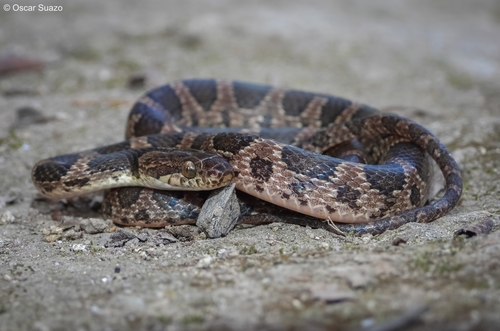
Rhombic Cat-eyed Snake
Leptodeira rhombifera
With its striking diamond patterns and mesmerizing vertical pupils, the Rhombic Cat-eyed Snake is a master of the Central American night. This gentle, nocturnal predator is a common but often unseen guest in suburban gardens and forest edges alike.
Quick Identification
Size
Adults typically reach 60 to 80 cm (24 to 31 inches) in length, though exceptional specimens may reach 100 cm (39 inches).
Colors
Light tan or yellowish-brown base with a series of large, dark brown or black diamond-shaped (rhombic) blotches along the back; the underside is uniform cream or pale yellow.
Key Features
- Vertical 'cat-like' pupils
- Distinct dark rhomboid blotches along the spine
- Wide, triangular head clearly distinct from the slender neck
- Rear-fanged with a mildly venomous bite
When You’ll See Them
Geographic range
Where Does the Rhombic Cat-eyed Snake Live?
Native to the lush and diverse landscapes of Central America, the Rhombic Cat-eyed Snake thrives across the isthmus. Its core range extends through Panama, Costa Rica, Nicaragua, Honduras, El Salvador, and into Guatemala. This adaptable species is a common sight in both lowland tropical regions and mid-elevation forests, often bridging the gap between wild woodlands and human-modified environments.
Basemap © OpenStreetMap contributors
Behavior
The Rhombic Cat-eyed Snake is a secretive, nocturnal hunter that emerges after sunset to patrol forest edges and garden perimeters. Known for its distinct vertical pupils that aid in low-light vision, it moves with a deliberate, slow grace, often spending time both on the ground and climbing in low-hanging vegetation. While it possesses mild venom used to subdue its prey, it is generally non-aggressive toward humans and will usually attempt to flee or hide if confronted.
These snakes are often found near water sources where their favorite prey congregates. During the day, they retreat into hollow logs, under leaf litter, or within the crevices of stone walls and buildings. In suburban environments, they are frequent visitors to patios and porches, especially if outdoor lighting attracts the insects that in turn attract the frogs and lizards these snakes hunt.
EverydayEarth exclusive
Camera Tips
To capture the Rhombic Cat-eyed Snake on camera, focus your efforts around water features. Garden ponds, drainage ditches, or even damp areas near outdoor faucets are prime locations because they attract frogs, the snake's primary food source. Position your camera low to the ground—about 12 to 18 inches—and angle it slightly downward to capture the snake as it prowls the leaf litter or follows a scent trail along the edge of a wall.
Since this species is strictly nocturnal, the quality of your camera's night vision is critical. Use a camera with high-quality Infrared (IR) or 'No-Glow' LEDs to avoid startling the animal with a bright white flash. Because snakes are ectotherms (cold-blooded), they don't always trigger traditional Passive Infrared (PIR) sensors as effectively as mammals do. To compensate, set your camera to its highest sensitivity level or use a 'Time-Lapse' mode with short intervals during the first few hours after sunset.
Environmental factors play a huge role in their visibility. The best time to get high-quality footage is during or immediately after a rain shower in the tropical wet season. The humidity brings out the amphibians, which in turn brings out the snakes. If you have outdoor lights that attract moths and beetles, place your camera nearby; the snake isn't interested in the bugs, but it will certainly show up to hunt the geckos and frogs that are.
Similar Species
Species that look similar or are commonly confused with Rhombic Cat-eyed Snake.
Frequently Asked Questions
Record Rhombic Cat-eyed Snake at your habitat
Connect a camera to start building your own species record — AI identifies every visitor automatically.