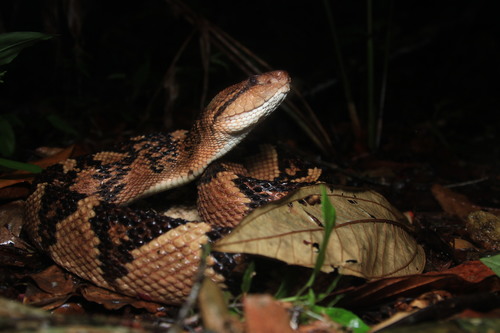
South American Bushmaster
Lachesis muta
The South American Bushmaster is the undisputed king of the rainforest floor. As the largest pit viper in the world, this master of camouflage thrives in the deepest, most undisturbed jungles of South America.
Quick Identification
Size
2.0 to 3.6 metres (6.5 to 12 feet) in length; weighs 3 to 5 kg (6.6 to 11 lbs)
Colors
Pale yellowish-tan or reddish-brown base with large, dark brown or black diamond-shaped rhombs; scales have a distinct bead-like, keeled texture
Key Features
- Large diamond-shaped markings along the back
- Rough, raised, bead-like scales
- Broad, triangular head with a dark stripe behind the eye
- World's longest pit viper
When You’ll See Them
Geographic range
Where Does the South American Bushmaster Live?
The South American Bushmaster is native to the humid tropical regions of South America and the Caribbean island of Trinidad. Its core range encompasses the vast Amazon Basin and the Atlantic Forest, with significant populations found in Brazil, Peru, Ecuador, Colombia, Bolivia, Venezuela, and the Guianas. As a deep-forest specialist, it is rarely found far from stable, high-canopy jungle environments where humidity remains high year-round.
Basemap © OpenStreetMap contributors
Behavior
The South American Bushmaster is a legendary ambush predator known for its immense patience. It often remains coiled and motionless in the leaf litter for weeks at a time, waiting for a rodent or small mammal to pass within striking range. Unlike most other New World pit vipers which give birth to live young, the Bushmaster is oviparous, meaning it lays eggs. Remarkably, the female often stays with her nest to guard the eggs until they hatch, a rare maternal behavior among snakes.
This species is almost exclusively nocturnal and highly terrestrial, rarely climbing trees. While it possesses a fearsome reputation due to its size and high venom yield, it is a shy, reclusive creature that avoids human settlements and prefers the deep, silent interior of primary forests. When threatened, it may vibrate its tail against dry leaves to create a sound that mimics a rattle, warning intruders to keep their distance.
EverydayEarth exclusive
Camera Tips
To capture a South American Bushmaster on camera, you must focus on the deep forest floor where they spend most of their lives. Look for large, buttressed trees or heavy fallen logs in primary rainforest; these structures serve as natural 'highways' for rodents, making them ideal ambush sites for the snake. Place your camera very low—about 12 inches (30 cm) from the ground—and angle it slightly downward to ensure the snake's intricate dorsal patterns are visible in the frame.
Because these snakes are strictly nocturnal, a camera with high-quality, 'no-glow' infrared flash is non-negotiable. Standard red-glow LEDs may not bother the snake, but 'no-glow' ensures that you don't attract or startle other forest wildlife. Set your trigger speed to the fastest possible setting; while the snake itself moves slowly, the prey that triggers the camera might be fast-moving rodents. Using a video mode (15-30 seconds) is often more rewarding than stills, as it captures the subtle flicking of the tongue and the snake's deliberate, flowing movement.
Bushmasters are highly sensitive to ground vibrations. When mounting your camera, ensure it is fixed to a sturdy, large-diameter tree that won't vibrate in the wind. Do not use lures or bait, as these snakes respond primarily to the heat signatures and scent trails of live prey. Instead, look for 'natural funnels'—narrow gaps between tree roots or rocks—where a snake is likely to pass through. Always wear snake-proof gaiters and use extreme caution when checking your camera in these environments, as the Bushmaster’s camouflage makes it nearly invisible against the forest floor.
Similar Species
Species that look similar or are commonly confused with South American Bushmaster.
Frequently Asked Questions
Record South American Bushmaster at your habitat
Connect a camera to start building your own species record — AI identifies every visitor automatically.