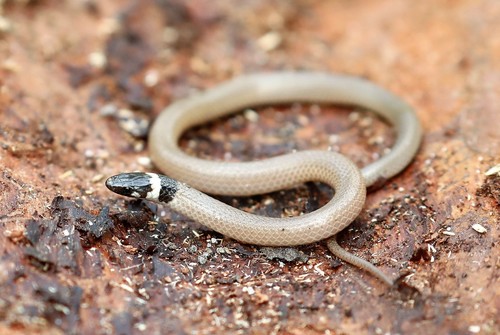
Southeastern Crowned Snake
Tantilla coronata
The Southeastern Crowned Snake is a hidden gem of the Southern backyard, featuring a striking black 'crown' and a gentle disposition. This tiny, harmless burrower plays a vital role in controlling garden pests like centipedes while staying tucked away beneath the leaves.
Quick Identification
Size
Small and slender, typically 8 to 10 inches (20-25 cm) in length, rarely exceeding 13 inches (33 cm).
Colors
Tan to reddish-brown body; jet-black head cap and neck band separated by a pale cream or yellow collar; white or yellowish underside.
Key Features
- Distinct black head cap ('crown')
- Light cream-colored collar between head and neck
- Small, slender build with smooth scales and a solid tan body
When You’ll See Them
Geographic range
Where Does the Southeastern Crowned Snake Live?
The Southeastern Crowned Snake is native to the Southeastern United States, where it is a common resident of the Coastal Plain and Piedmont regions. Its range stretches from southern Virginia south into the Florida panhandle and extends westward through the Gulf States into parts of Mississippi and eastern Louisiana. These snakes are particularly concentrated in areas with sandy soils and plentiful leaf litter, thriving in the warm, humid environments of the American South.
Basemap © OpenStreetMap contributors
Behavior
The Southeastern Crowned Snake is a secretive, fossorial species that spends the vast majority of its life underground or hidden beneath organic debris. They are incredibly docile and are known for their calm temperament; even when uncovered or handled, they almost never attempt to bite. Instead of defense, they rely on their small size and earth-toned coloration to remain undetected by predators like birds and larger snakes.
These snakes are primarily nocturnal and emerge from their subterranean tunnels at night to forage among leaf litter. While they possess tiny rear fangs and a mild venom used to subdue their specific prey, they are completely harmless to humans and domestic pets. In suburban settings, they often go unnoticed for years, living quietly in mulch beds and under landscaping timbers.
EverydayEarth exclusive
Camera Tips
To capture the Southeastern Crowned Snake on camera, you must think small and low. These snakes rarely leave the ground, so your camera needs to be mounted just inches above the soil. Position your device near natural 'corridors' where they are likely to travel, such as the edge of a garden bed, along the side of a fallen log, or near a pile of damp pine straw. Because of their tiny size, a camera with a short minimum focus distance is essential to avoid blurry footage.
Since they are strictly nocturnal, ensure your camera's infrared (IR) flash is optimized for close-range subjects to prevent 'white-out' on the snake's reflective scales. Setting your camera to record 10-15 second video clips is often more effective than still photos, as the unique side-to-side movement of the snake helps distinguish it from the surrounding twigs and leaves. High-sensitivity PIR sensors are helpful, but since these snakes are cold-blooded, the sensor may rely more on the snake's movement across the frame than a heat signature.
A great trick for backyard observers is to place a 'cover board'—a flat piece of untreated plywood or a large flat stone—in a shaded area of the yard. Wait a few weeks for the soil underneath to become moist and attract invertebrates. Position your camera to monitor the perimeter of the board; you are likely to catch this species as it emerges at dusk to begin its nightly hunt for centipedes.
Similar Species
Species that look similar or are commonly confused with Southeastern Crowned Snake.
Frequently Asked Questions
Record Southeastern Crowned Snake at your habitat
Connect a camera to start building your own species record — AI identifies every visitor automatically.