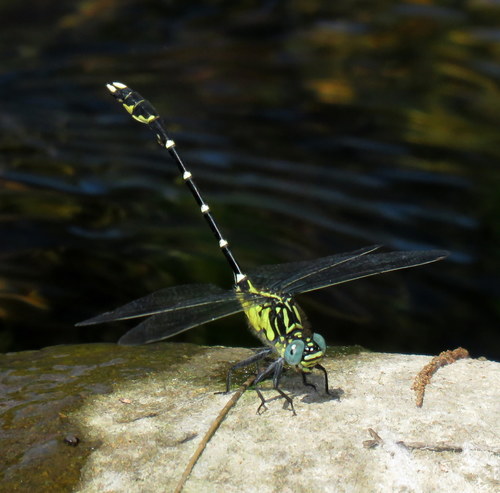
Stout Vicetail
Hemigomphus heteroclytus
A striking yellow-and-black hunter of the Australian east coast, the Stout Vicetail thrives where other dragonflies falter. Watch for this robust 'clubtail' as it patrols the rocky pools and summer trickles of the bush.
Quick Identification
Size
Body length 40–50 mm (1.6–2.0 in); wingspan 55–65 mm (2.2–2.6 in)
Colors
Deep black base with vivid yellow stripes on the thorax and yellow-gold markings on each abdominal segment
Key Features
- Bold yellow thoracic stripes forming a 'Y' or 'V' shape
- Distinctly widened or 'clubbed' segments at the end of the abdomen
- Separated eyes, a classic trait of the Gomphidae family
- Short, robust build compared to other vicetail species
When You’ll See Them
Geographic range
Where Does the Stout Vicetail Live?
The Stout Vicetail is native to the continent of Australia, where it is found exclusively along the eastern seaboard. Its range stretches from the coastal and highland regions of southeastern Queensland, through the river systems of New South Wales, and into eastern Victoria. It is an endemic species, perfectly suited to the temperate and subtropical climates of the Great Dividing Range and its surrounding foothills.
Basemap © OpenStreetMap contributors
Behavior
The Stout Vicetail is a specialized predator of the Australian waterways, spending its adult life as an aerial hunter. Unlike many dragonflies that prefer high-velocity rivers, this species is uniquely adapted to smaller streams and creeks that may dwindle to mere trickles or isolated pools during the heat of the Australian summer. They are frequently seen perching on sun-bleached rocks or low-hanging branches, using these vantage points to scan for passing prey.
Males are notably territorial, patrolling specific stretches of a stream and aggressively chasing off rivals. When the sun is at its peak, they often adopt an 'obelisk' posture—raising their abdomen vertically—to minimize the surface area exposed to direct sunlight and prevent overheating. To humans, they are entirely harmless and serve as a fascinating example of the biodiversity found in eastern Australian riparian corridors.
EverydayEarth exclusive
Camera Tips
To successfully capture a Stout Vicetail on your backyard or trail camera, focus your efforts on 'perch management.' These dragonflies are creatures of habit and will often return to the exact same sun-drenched rock or twig after a hunting flight. Position your camera on a mini-tripod just 12–18 inches above the water level, aimed at a prominent, flat rock that receives direct midday sun. This is where they are most likely to land to regulate their body temperature.
Because dragonflies are small and fast, the trigger speed of your camera is critical. If you are using an AI-powered camera with a motion sensor, ensure it is set to its most sensitive 'small animal' or 'insect' mode. If your camera allows for manual focus, pre-focus on a specific branch or rock (the 'bait' perch) to ensure the dragonfly is crisp when it lands. Lighting is your best friend—aim for a spot where the sun hits the perch directly between 11 AM and 2 PM to highlight the brilliant yellow and black contrast on their bodies.
You can 'lure' a Stout Vicetail by creating the perfect habitat in your camera's frame. If the local stream is overgrown, gently clear a small 2-foot window of visibility and place a single, clean, dry stick or dark river stone in the center. The dragonfly will prefer this clear vantage point over tangled vegetation. For the best results, use a camera with high-speed burst mode or high-definition video to capture the moment they transition from a still perch to an explosive takeoff.
Similar Species
Species that look similar or are commonly confused with Stout Vicetail.
Frequently Asked Questions
Record Stout Vicetail at your habitat
Connect a camera to start building your own species record — AI identifies every visitor automatically.