Troublesome Sedge
Carex molesta
A resilient and adaptable North American native, the Troublesome Sedge thrives where other plants falter, offering vital habitat and golden-hued beauty to backyard ecosystems.
Quick Identification
Size
Grows in tufts reaching 30 to 90 cm (12 to 36 inches) tall, with leaves approximately 3 to 6 mm wide.
Colors
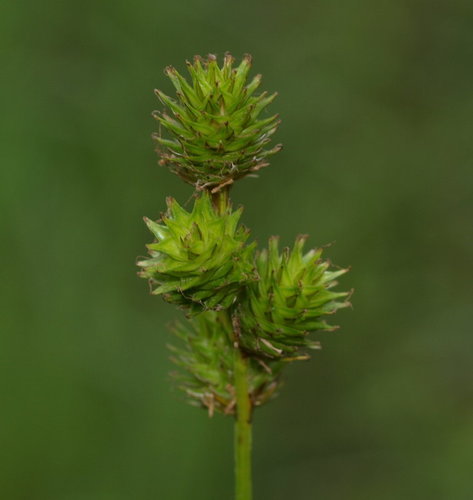
Bright green leaves and stems; fruiting clusters (perigynia) are initially light green, maturing to a distinctive straw-yellow or golden brown.
Key Features
- Compact seed heads with 2-5 globose spikelets
- Broadly winged, nearly circular perigynia (seed casings)
- Stiff, upright triangular stems
- Tufted, non-creeping growth habit
When You’ll See Them
Geographic range
Where Does the Troublesome Sedge Live?
Troublesome Sedge is widely distributed across central and eastern North America. Its native territory spans from the southern reaches of Canada down through the Great Plains and eastward to the Atlantic coast, with a high concentration in the Midwestern United States. While it is a natural component of these temperate ecosystems, it has also been introduced to the West Coast, particularly in California, where it is often found in moisture-retaining disturbed habitats.
Basemap © OpenStreetMap contributors
Behavior
Despite its name, the Troublesome Sedge is not particularly aggressive in its native range; its name likely stems from the difficulty botanists have in distinguishing it from its close relatives. It grows in a 'caespitose' or tufted manner, meaning it forms neat clumps rather than spreading via long, invasive runners. This makes it a well-behaved addition to a native plant garden, where it provides structural interest and ground cover.
As a cool-season plant, it does most of its growing during the spring and early summer. It is incredibly resilient to environmental stress, capable of thriving in areas that fluctuate between being soggy in the spring and bone-dry in the summer. In the wild, it acts as a pioneer species, often being one of the first plants to colonize disturbed soil along roadsides or in newly restored prairies.
EverydayEarth exclusive
Camera Tips
Capturing the Troublesome Sedge on a backyard camera requires a focus on detail rather than motion. To get the best shots of its unique 'troublesome' seed heads, set your camera or smartphone to a macro setting. Place your camera at a low angle, roughly 12 to 18 inches off the ground, to highlight the structure of the culms (stems) against the sky or a contrasting background. This low perspective helps differentiate the plant's profile from surrounding grasses.
Because the AI-powered cameras on our platform are often triggered by movement, you may find that the sedge records frequently during windy days. Use this to your advantage by observing how the plant sways; the stiffness of the stem is a key ID feature. If you are using a trail camera to monitor wildlife, plant Troublesome Sedge in the foreground. Its seeds are a food source for several species of ground-feeding birds and small mammals, providing a natural 'lure' that keeps subjects in the frame for longer periods.
For the best lighting, aim for the 'golden hour'—shortly after sunrise or before sunset. The low-angled light catches the translucent 'wings' of the perigynia, making them glow and highlighting the fine details needed for a positive AI identification. During the winter, keep your camera active; even when the plant turns brown, its skeletal structure remains upright, providing excellent texture for winter landscape shots and shelter for overwintering insects that may attract hungry birds.
Similar Species
Species that look similar or are commonly confused with Troublesome Sedge.
Frequently Asked Questions
Record Troublesome Sedge at your habitat
Connect a camera to start building your own species record — AI identifies every visitor automatically.