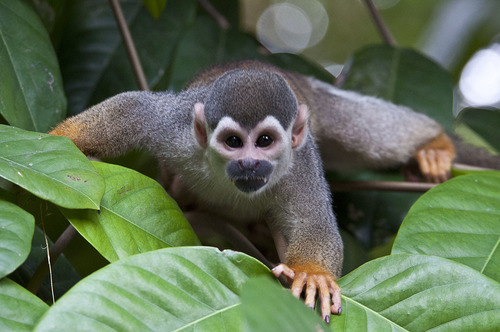
Golden-backed Squirrel Monkey
Saimiri ustus
A vibrant and acrobatic inhabitant of the Amazonian canopy, the Golden-backed Squirrel Monkey is famous for its striking yellow fur and social complexity. These 'bare-eared' wonders bring a burst of energy and color to the tropical treetops.
Quick Identification
Size
Body: 25-37 cm (10-15 in); Tail: 36-45 cm (14-18 in); Weight: 0.6-1.1 kg (1.3-2.4 lbs)
Colors
Golden-yellow back and limbs, greyish-brown crown, white 'mask' around eyes, and characteristic bare, pinkish-grey ears.
Key Features
- Distinct hairless, bare ears lacking white tufts
- Golden-yellow fur across the back and forearms
- White 'mask' around eyes forming a high Gothic arch
- Long, non-prehensile tail with a black tip
When You’ll See Them
Geographic range
Where Does the Golden-backed Squirrel Monkey Live?
Native to the heart of the South American continent, the Golden-backed Squirrel Monkey is primarily found in the central Amazon basin of Brazil. Its range extends south of the Amazon River and east of the Madeira River, reaching into the northern fringes of Mato Grosso. While its presence in eastern Bolivia is suspected, the core of its population remains within the dense, river-fed forests of the Brazilian interior.
Basemap © OpenStreetMap contributors
Behavior
In the wild, they are highly vocal, using a variety of chirps and whistles to maintain group cohesion while foraging. While they are generally wary of humans, they can become habituated to observation in areas where they aren't hunted, often ignoring trail cameras once they determine the device isn't a predator.
EverydayEarth exclusive
Camera Tips
Because squirrel monkeys move incredibly fast, you must prioritize a high shutter speed or 'fast' trigger setting on your trail camera. A delay of even half a second might result in nothing but a blurry tail in your frame. Set your camera to 'burst mode' or a short video clip (10-15 seconds) to capture the social interactions of the troop as they follow one another across the branches.
In a backyard or garden setting near their forest habitat, you can attract them using water features or native fruit plantings like guava or figs. If you use bait, ensure it is placed in a secure basket high in the trees to prevent it from being stolen by terrestrial scavengers. Early morning and late afternoon provide the best natural lighting for their golden fur, making the colors 'pop' against the green canopy.
Similar Species
Species that look similar or are commonly confused with Golden-backed Squirrel Monkey.
Common Squirrel Monkey
The Common Squirrel Monkey has prominent white hair tufts on its ears, whereas the Golden-backed species has bare ears.
Black-capped Squirrel Monkey
Features a much darker, nearly black 'cap' on the head and a more distinct Roman-arch facial pattern compared to the Golden-backed's Gothic-arch.
Frequently Asked Questions
Record Golden-backed Squirrel Monkey at your habitat
Connect a camera to start building your own species record — AI identifies every visitor automatically.