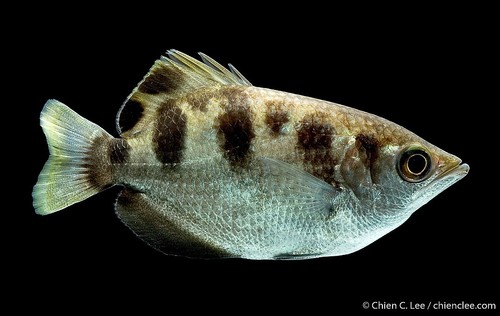
Spotted Archerfish
Toxotes chatareus
Meet the sharpshooter of the mangroves. The Spotted Archerfish is a remarkable predator that uses a pressurized jet of water to hunt insects from the air with mathematical precision.
Quick Identification
Size
20-30 cm (8-12 in) on average, reaching up to 40 cm (16 in); weight up to 1 kg (2.2 lbs)
Colors
Silvery-white to pale golden body with 6-7 dark, vertically elongated spots or blotches along the upper flanks
Key Features
- Pointed snout with a wide, upturned mouth
- 6-7 dark irregular spots along the upper body
- Large, forward-facing eyes positioned for binocular vision
- Deep, laterally compressed body shape
- Single dorsal fin set far back toward the tail
When You’ll See Them
Geographic range
Where Does the Spotted Archerfish Live?
Native to the tropical Indo-Pacific region, the Spotted Archerfish maintains a sprawling presence across Southeast Asia and Northern Australia. Its core range extends from the eastern coast of India through Thailand, Malaysia, and Indonesia, reaching as far as Papua New Guinea and the northern tropical rivers of Australia. While primarily a coastal resident, it is frequently found quite far inland in freshwater systems that remain connected to the sea.
Basemap © OpenStreetMap contributors
Behavior
The Spotted Archerfish is a master of ballistic precision, world-renowned for its ability to 'shoot' down terrestrial insects by spitting a high-pressure jet of water. By pressing its tongue against a groove in the roof of its mouth, it creates a barrel that can propel water droplets up to 1.5 meters (5 feet). These fish are remarkably intelligent, capable of accounting for the refraction of light at the water's surface to hit targets with incredible accuracy.
While they are solitary hunters when mature, juveniles often form small schools for protection in mangrove roots. They are highly competitive feeders; as soon as an insect hits the water, every archerfish in the vicinity will dash toward it. In areas with human activity, they are known to become quite bold, often lurking under docks or garden boardwalks to wait for insects attracted by artificial lights or human presence.
EverydayEarth exclusive
Camera Tips
To capture the Spotted Archerfish's famous 'spitting' behavior, position your camera with a clear view of overhanging vegetation. In a backyard or garden setting that borders a canal or pond, identify a specific branch or leaf that hangs 1 to 3 feet above the water line. This is the 'kill zone' where archerfish look for prey. Because their hunting strike occurs in a fraction of a second, using a camera capable of high-speed video (at least 60 or 120 frames per second) is essential to see the water jet in detail during playback.
If you are using a trail camera or a mounted AI camera, try to angle it parallel to the water's surface rather than looking straight down. This side-on perspective is the best way to capture the trajectory of the water droplet as it leaves the fish's mouth. For those with docks or overhanging decks, mounting the camera just a few inches above the water line will provide the most dramatic, 'National Geographic' style footage of the fish surfacing to take its shot.
Artificial lighting can be a fantastic lure for these fish. At night, a soft LED light positioned to shine directly onto overhanging leaves will attract moths, flies, and other nocturnal insects. Spotted Archerfish are opportunistic and will quickly learn that your 'light trap' is a consistent source of food. If your camera has a pre-trigger or 'loop recording' feature, enable it; the fish often hovers for several seconds to aim before firing, which gives the sensor plenty of time to wake up and start recording the action.
Similar Species
Species that look similar or are commonly confused with Spotted Archerfish.
Frequently Asked Questions
Record Spotted Archerfish at your habitat
Connect a camera to start building your own species record — AI identifies every visitor automatically.